He Asked Synaptics for Help With a Linux Driver. The Reply Was a $25,000 a Week Legal Demand.
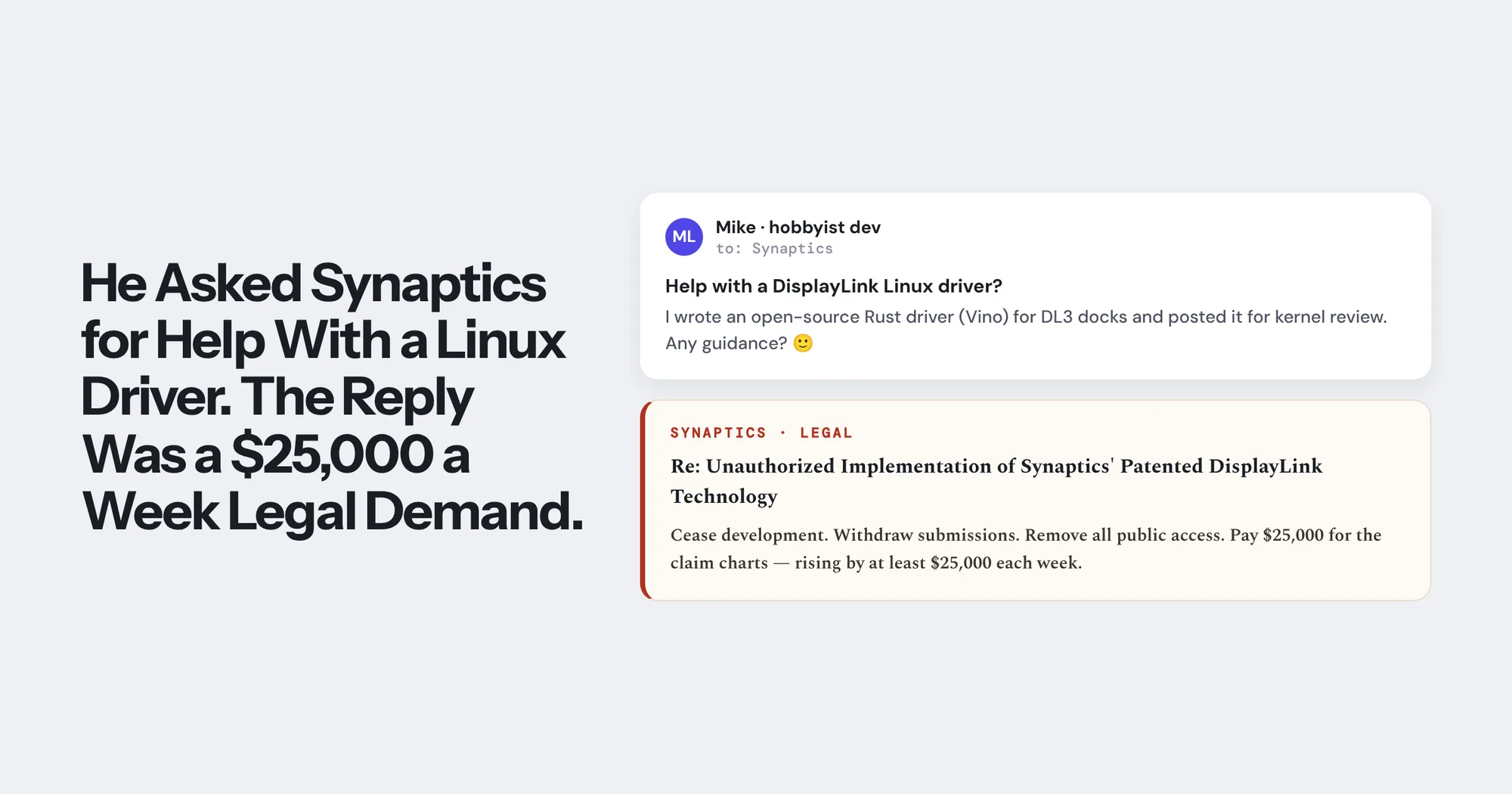
A hobbyist wrote an open source Rust driver for DisplayLink docks and posted it for kernel review. Synaptics answered with patent letters, the repository is offline, and no court has ruled on anything. I go through the dates, the 2 patents and how far a clean room reaches.
Last verified
On this page
In June 2026, a developer named Mike Lothian posted an open source Linux driver for DisplayLink docks to the kernel mailing lists. By November 4 the code had gone from GitHub. I want to walk through what the driver was, what Synaptics sent him, how he answered, and what the dispute says about reverse engineering hardware you bought.
One caution before the details. Everything public here is correspondence and reporting. Synaptics has made no public statement, per It’s FOSS, and WindowsForum’s summary makes the point that the record shows a patent dispute, with no court finding that the driver infringes or that the patents are invalid.
What DisplayLink is and why Linux users wanted a new driver
DisplayLink lets a computer drive extra monitors over USB. The host compresses the picture, sends it down the cable, and a chip in the dock unpacks it. That is why a laptop with 1 video port can run several screens through a dock. Synaptics bought the company in 2020. Its press release filed with the SEC put the price at $305 million in cash, and a later filing shows the deal closed on July 31, 2020. Synaptics expected the business to add about $94 million in annual sales, per Design & Reuse.
The same press release lists the supported systems as Windows, MacOS, ChromeOS and Ubuntu Linux. On Linux the official route has 2 parts, an open kernel module called EVDI and a closed program called DisplayLinkManager. Neither lives in the mainline kernel. Phoronix notes that the original USB2 era DisplayLink hardware worked well on Linux and even had open source driver support, so the gap is in the newer generations.
What Vino was
Lothian called his driver Vino. His first posting on June 17 describes it as a clean room Rust driver that runs inside the kernel for DisplayLink DL3 docks such as the Dell Universal Dock D6000, meant as a native replacement for EVDI plus DisplayLinkManager. He posted it as a request for comments in a deliberately incomplete state and asked for help. Phoronix covered it the same day.
He was open about his tools. The cover letter says the implementation was AI assisted, and that the reverse engineering, the testing on a physical D6000 and responsibility for the code were his. LAVX News reports he used Claude Code with the Opus 4.8 model, and the version 2 patches from July 2 carry an Assisted by tag naming a Claude Sonnet model. The main driver file in that version ran to 2,617 lines. Version 2 grew to 10 patches covering the handshake, the framebuffer codec, a hardware cursor and monitor controls, and he posted a Rust rewrite of EVDI alongside it. It’s FOSS says he eventually had Vino working on 3 generations of DisplayLink docks.
How a request for help became a legal file
The sequence comes mostly from It’s FOSS, which credits LWN for part of it. In early July, Lothian emailed a Synaptics employee for guidance and mentioned his Rust rewrite of EVDI. About 2 weeks later a different Synaptics employee replied that the EVDI rewrite was fine. The concern was the DisplayLink protocol and codec, which Synaptics believes its patents cover.
On August 17, Synaptics sent a cease and desist letter. It demanded that development stop, that submitted work be withdrawn, and that a signed confirmation arrive by August 28. An appendix listed over 125 patents without saying which ones applied. Lothian posted a working version 3 on August 26 and asked the next day which claims the company had in mind.
The answer came in October. A letter dated October 5, on Synaptics letterhead and titled “Unauthorized Implementation of Synaptics’ Patented DisplayLink Technology,” enclosed 2 claim charts. They map claim 11 of GB2484736 and claim 11 of GB2485613 to his code. The letter also demanded that he remove and permanently disable public access to the implementation, including source code, patches, forks and kernel submissions.
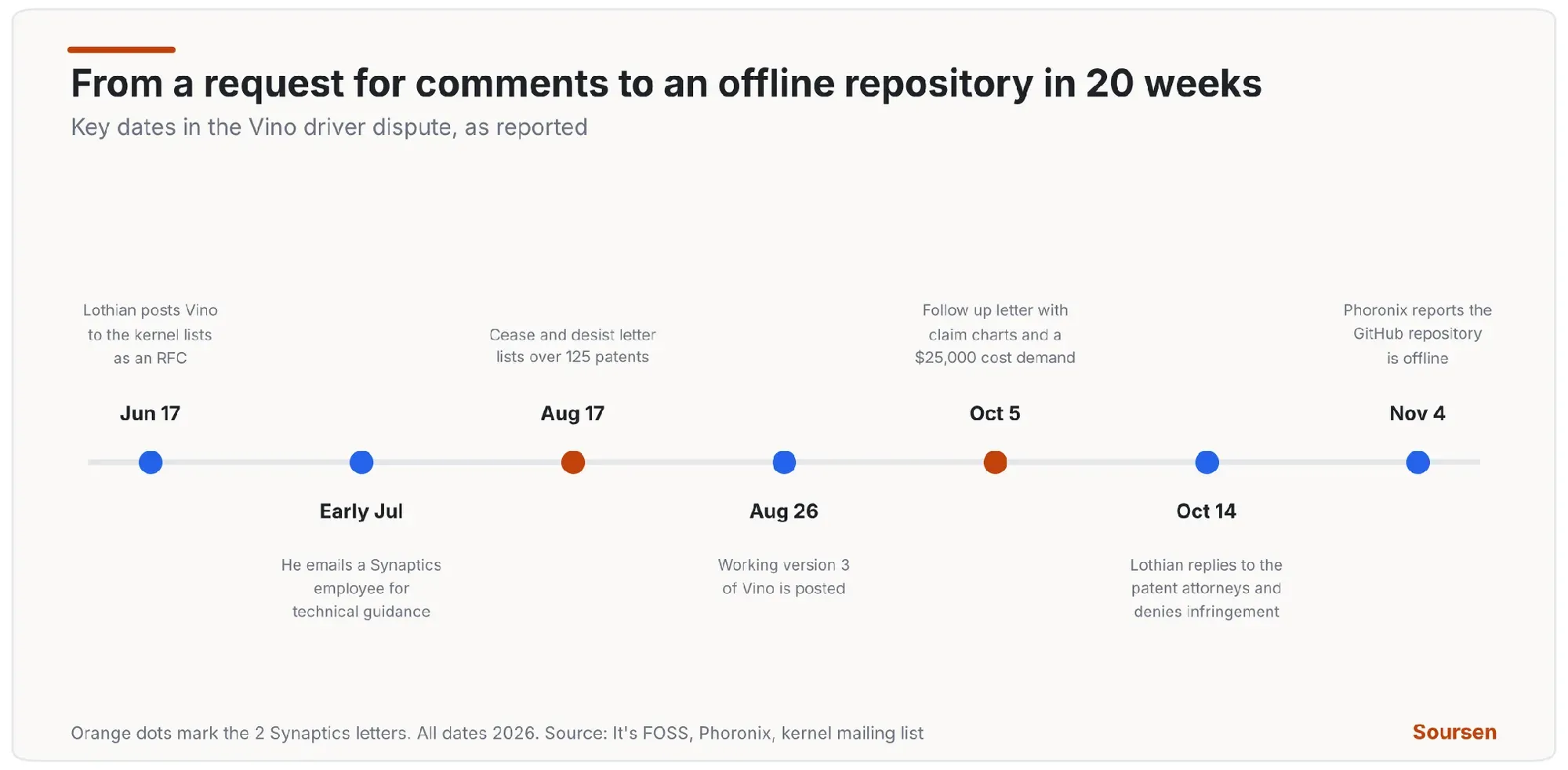
From a request for comments to an offline repository in 20 weeks. The 2 orange dots are the Synaptics letters. Source: It’s FOSS, Phoronix, kernel mailing list
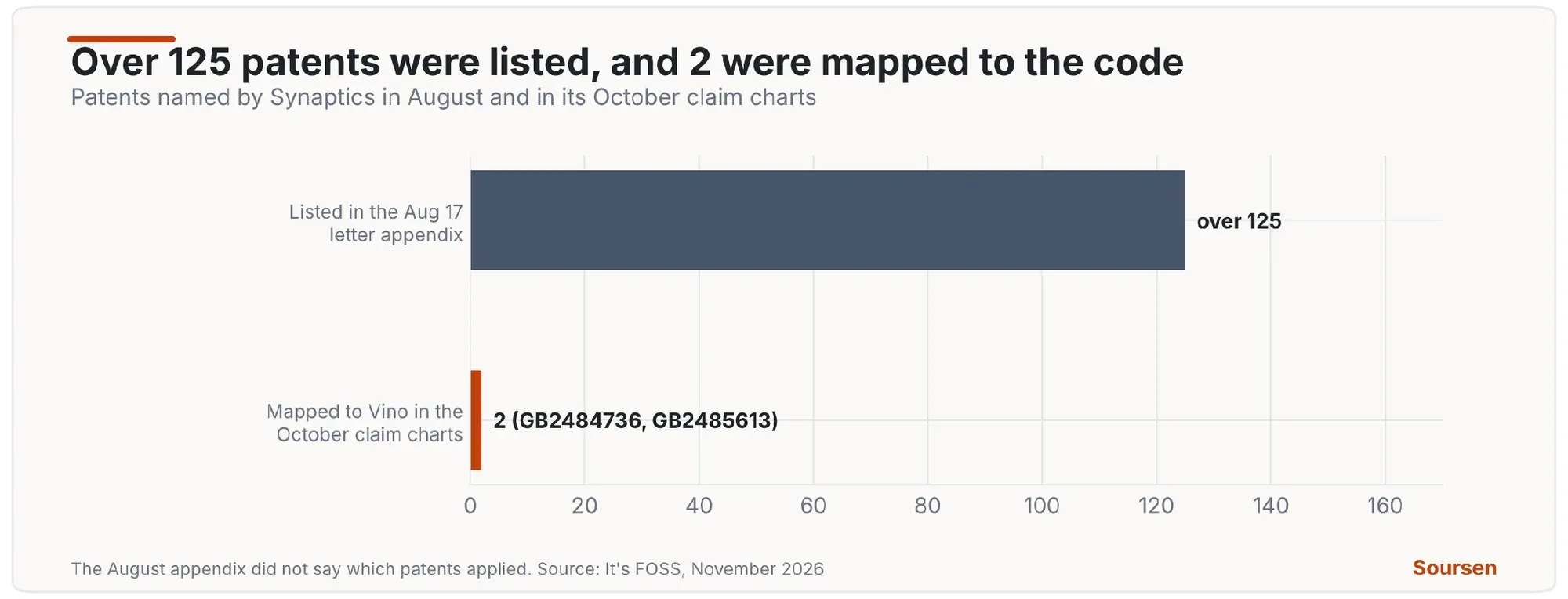
Over 125 patents were listed, and 2 were mapped to the code. The August appendix did not say which patents applied. Source: It’s FOSS, November 2026
The $25,000 clock
The October 5 letter carried a price. It’s FOSS reports that Synaptics said it would seek $25,000 for the cost of preparing the claim charts if Lothian missed an October 11 deadline, with the figure rising by at least $25,000 each week. Those were the charts he had asked for in August. VideoCardz describes it as a threat to bill him for documenting the infringement claims.
On October 6, Lothian offered to pause public work on the encoding code if Synaptics paused the deadline and the weekly charge, and he asked about a license for non commercial use. On October 7, Synaptics said it would grant no patent license and make no promise not to sue, and set October 18 as a final deadline. I have seen no report of any payment, and no report of a lawsuit.
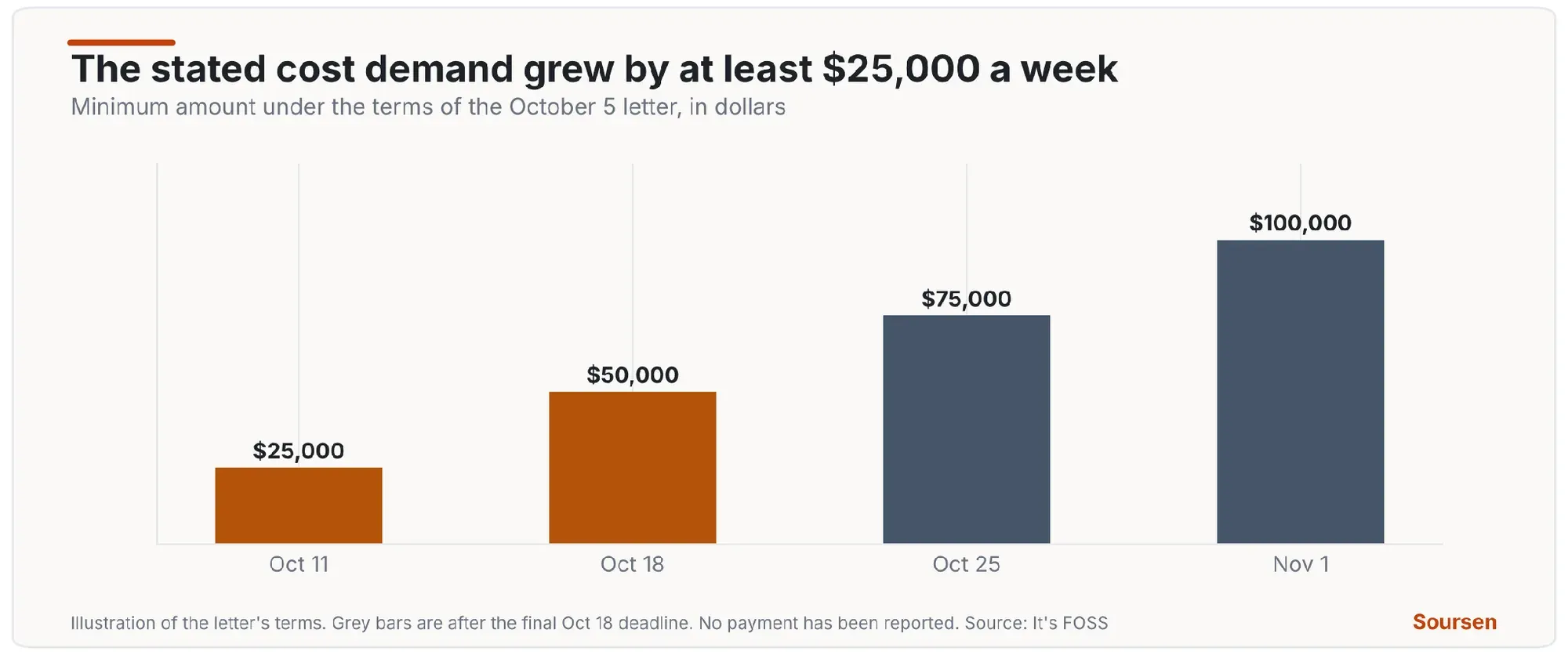
The stated cost demand grew by at least $25,000 a week. This chart illustrates the letter’s terms, and no payment has been reported. Source: It’s FOSS, November 2026
Lothian’s reply
A firm of UK patent attorneys wrote to him on October 14, and he answered the same day and published the exchange on the kernel mailing list. MLQ identifies the letter as coming from Synaptics’s UK patent attorneys. BrainDetox’s summary of the thread says he described himself as an individual hobbyist developer without legal representation, denied that any act of his infringes either patent, and reserved his rights. He then made 3 points.
The first is where a case would be heard. He lives in Scotland, and he cites Schedule 4 to the Civil Jurisdiction and Judgments Act 1982 for the rule that a person domiciled in Scotland is to be sued in Scotland. He says he would expect any proceedings in the Court of Session and would contest an attempt to bring them elsewhere.
The second is validity. In his telling, the attorneys’ letter said it does not matter whether the inventions are easy or familiar while the patents remain in force. He disagrees, and points to the Patents Act 1977, under which invalidity is a defense and a defendant can counterclaim for revocation. His reply says the claims were granted only after amendments that added delivery of display data over a general purpose data network, and that this feature was already public. He cites the RFB protocol behind VNC from January 1998, and 2 US patents with priority dates of 1994 and 1997. WindowsForum is right to label these as his proposed grounds for a challenge. Nobody has tested them.
The third is the Open Invention Network. OIN runs a patent cross license in which members share patents covering a defined list of Linux packages, and its own overview calls it the world’s largest patent non aggression community. Lothian wrote that Synaptics is an OIN licensee and that he became one on August 17, the day of the first letter. He understands Synaptics’s position to be that its OIN license does not reach the DisplayLink patents, and he asked the attorneys to name the provision they rely on. The correspondence does not settle that question.
He closed by noting that the letter asked nothing of him beyond acknowledging receipt, and Tom’s Hardware reports he remains open to a “sensible resolution.”
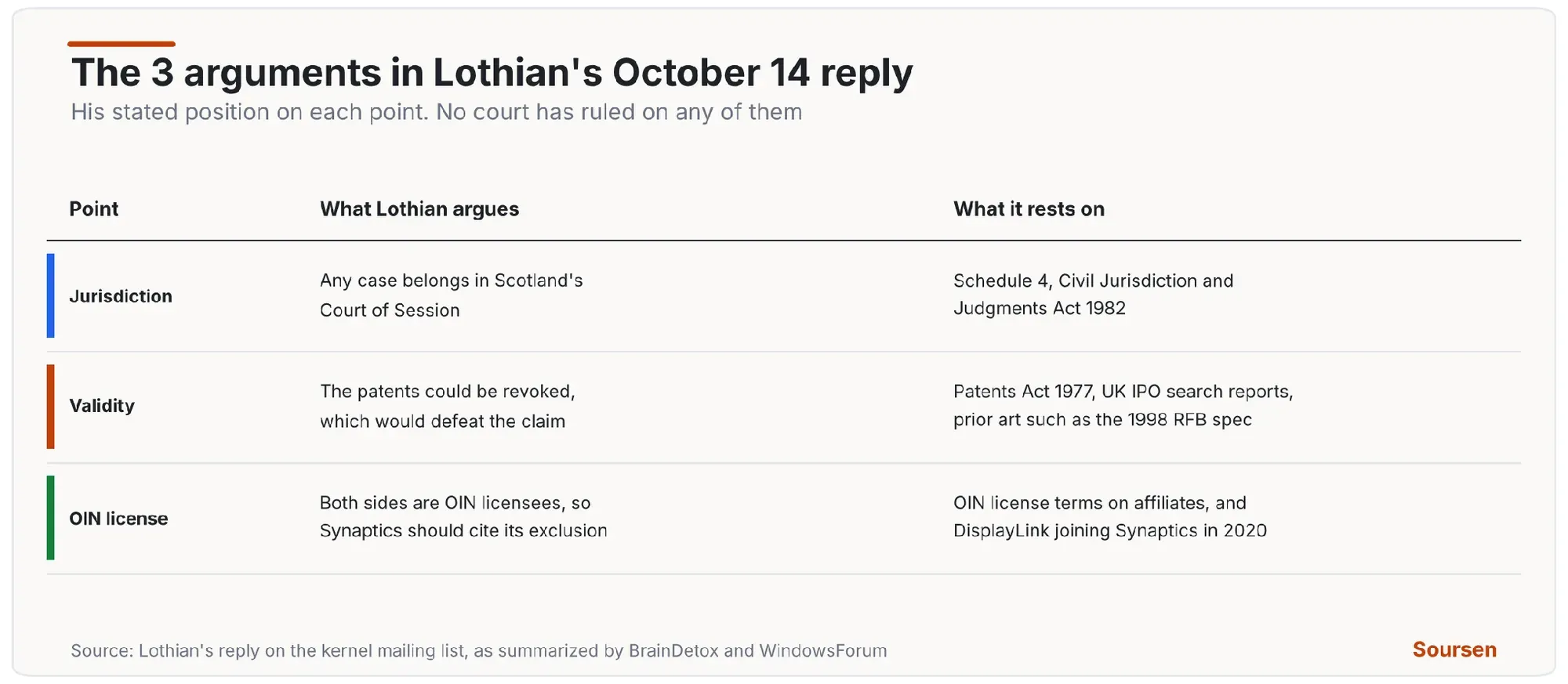
The 3 arguments in Lothian’s October 14 reply. No court has ruled on any of them. Source: Lothian’s reply on the kernel mailing list, as summarized by BrainDetox and WindowsForum
Where the driver stands
Phoronix reported on November 4 that the Vino repository on GitHub is no longer publicly available, and told readers to expect no open source upstream DisplayLink driver soon. Tom’s Hardware says Lothian took the repository offline himself. The patches he mailed in June, July and August are still in the public list archives.
For the kernel, the practical effect is a stall. I would expect maintainers to hold off on merging a driver while its author faces a live patent demand, and Lothian has no license offer on the table. For users, the official EVDI and DisplayLinkManager route still works on the systems Synaptics supports.
A clean room covers copyright, and this is a patent claim
Lothian says he reverse engineered Vino from captured USB traffic and vendor programs. It’s FOSS describes the classic clean room as a 3 party process, where one party studies the original, another writes a description, and a third builds from the description alone. The point of that method is to show nobody copied code. MLQ notes that Synaptics does not claim he copied its code.
Patents work differently. A patent covers a method, so code written from scratch can still fall inside a claim. It’s FOSS reports that Synaptics made exactly this argument in its July reply. That leaves a patent defendant with a short list of answers, which are that the claim does not read on the code, that the patent is invalid, or that a license applies. Lothian is arguing the last 2.
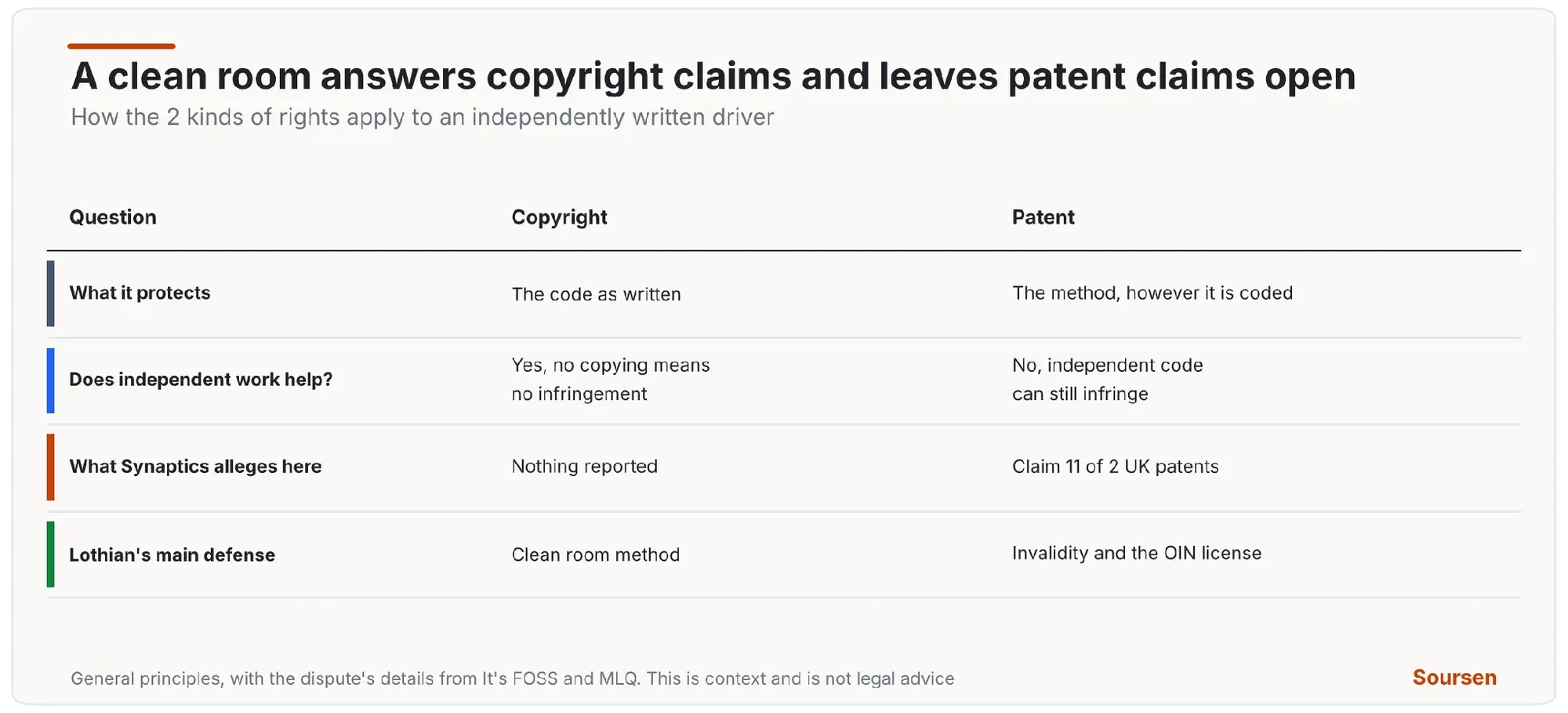
A clean room answers copyright claims and leaves patent claims open. This is general context and is not legal advice. Source: It’s FOSS and MLQ, November 2026
This has happened to Linux display support before, with a standards body in place of a patent holder. In February 2024, Phoronix reported that the HDMI Forum turned down AMD’s request to ship HDMI 2.1 support in its open source driver, after AMD engineers had working code and spent months with their legal team. Users were pointed to DisplayPort.
The AI question
Every headline mentions Claude. The letters, as reported, rest on patents, and nothing public shows Synaptics objecting to how the code was written. I would still treat AI as a risk in reverse engineering work for a separate reason. A clean room argument depends on showing what the author saw, and a person using a cloud model cannot list what that model was trained on. That concern sits under copyright law, and this dispute so far sits under patent law. It’s FOSS adds that legal pressure has reached other AI built projects in the same period.
2 things from this generalize
The first is that reverse engineering and patents are separate problems. Capturing USB traffic from a dock you own and writing your own code handles the copying question. A patent on the method the dock uses is still in play, and a vendor can list over 125 of them before naming 2.
The second is that the paper trail matters. Lothian asked which claims applied, got charts, answered point by point, and published the exchange. Because of that, anyone can read the 2 patent numbers and his prior art list and judge the dispute on its documents.
This week, if I maintained a driver built from reverse engineering, I would search the vendor’s patents for the protocol and the codec, and read the OIN Linux System list to see whether my package is covered.
Sources
- The AI Assisted Linux Driver for DisplayLink Gets Legal Notice, It's FOSSitsfoss.com. Accessed 16 November 2026.
- Synaptics Appears To Use Legal Threats To Block Open Source DisplayLink Driver, Phoronixphoronix.com. Accessed 16 November 2026.
- Experimental Rust Driver Targets Modern DisplayLink Hardware, Phoronixphoronix.com. Accessed 16 November 2026.
- RFC PATCH 0/7 drm/vino, LWNlwn.net. Accessed 16 November 2026.
- RFC PATCH v2 00/10 drm/vino, kernel mailing listlkml.iu.edu. Accessed 16 November 2026.
- RFC PATCH v2 06/10 drm/vino, kernel mailing listlkml.iu.edu. Accessed 16 November 2026.
- Rust EVDI virtual display driver, kernel mailing listlkml.iu.edu. Accessed 16 November 2026.
- Synaptics letter of October 5, 2026, dri-devel archivelists.freedesktop.org. Accessed 16 November 2026.
- Synaptics sends cease and desist order, Tom's Hardwaretomshardware.com. Accessed 16 November 2026.
- Synaptics threatens developer, VideoCardzvideocardz.com. Accessed 16 November 2026.
- Synaptics Demands Halt to Vino, WindowsForumwindowsforum.com. Accessed 16 November 2026.
- Vino DisplayLink driver offline, BrainDetoxbraindetox.kr. Accessed 16 November 2026.
- Synaptics uses DisplayLink patents, MLQmlq.ai. Accessed 16 November 2026.
- Vino Rust driver targets newer DisplayLink docks, LAVX Newsnews.lavx.hu. Accessed 16 November 2026.
- Synaptics to Acquire DisplayLink, SEC exhibitsec.gov. Accessed 16 November 2026.
- Synaptics completes DisplayLink merger, SEC 8-Ksec.gov. Accessed 16 November 2026.
- Synaptics to Acquire DisplayLink, Design & Reuseus.design-reuse.com. Accessed 16 November 2026.
- OIN corporate overview, Open Invention Networkopeninventionnetwork.com. Accessed 16 November 2026.
- HDMI Forum Rejects Open Source HDMI 2.1 Driver Support, Phoronixphoronix.com. Accessed 16 November 2026.
Related stories

Linux & open source
The Linux Kernel Just Dropped Its AI Disclosure Tag, and the Fight Over It Says More Than the…
At the Maintainer Summit in Prague, the people who run the Linux kernel reached a rough consensus to deprecate the Assisted-by tag, the little line in a commit that says AI helped write it. I went through who proposed it, the real numbers behind it, and the argument it set off, including Linus Torvalds calling the whole idea of AI disclosure rules utterly stupid, because the kernel is quietly becoming one of the most AI touched projects in open source.
Linux & open source
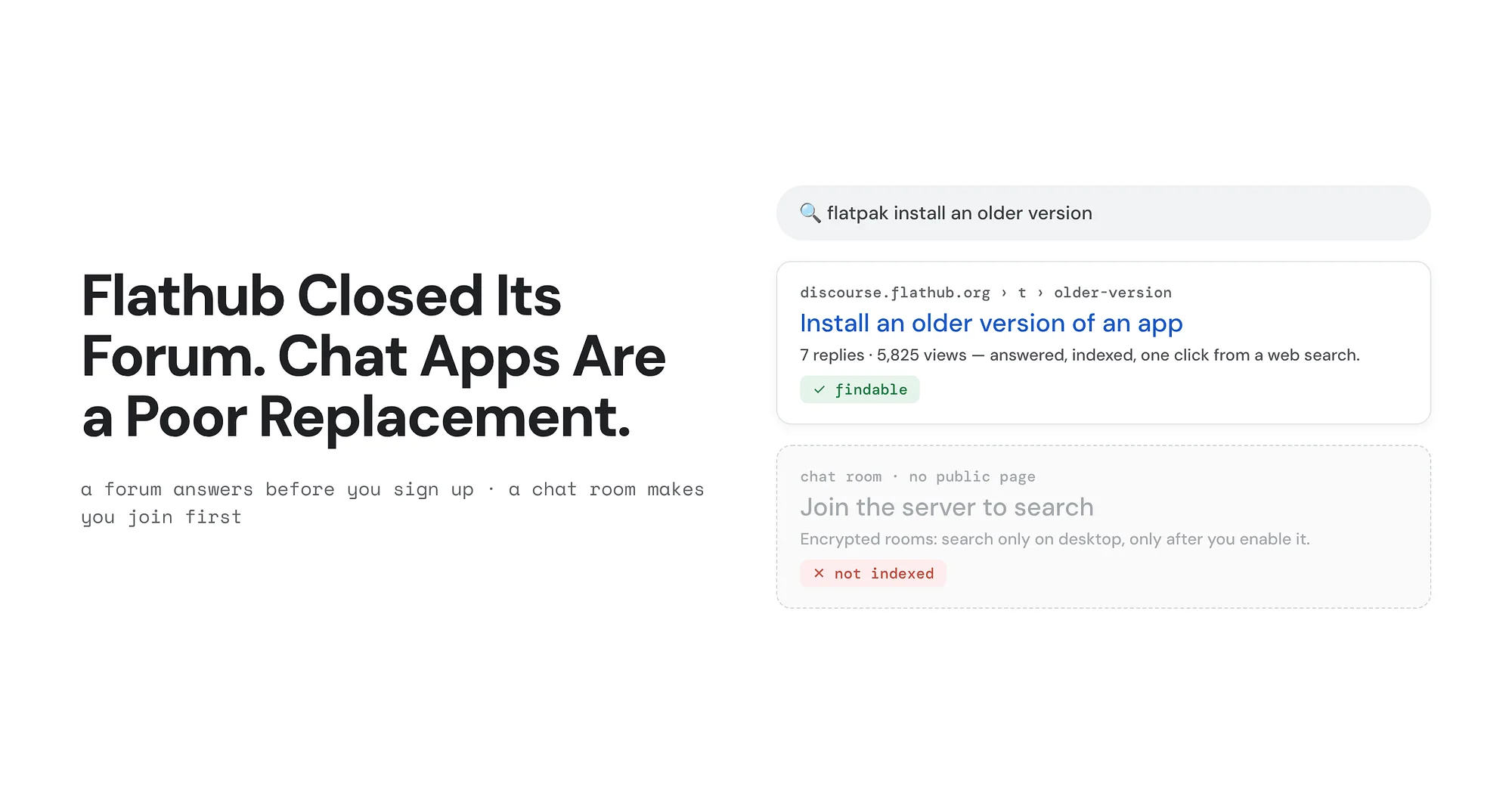
Flathub Closed Its Forum. Chat Apps Are a Poor Replacement.
On October 23, 2026, Flathub made its Discourse forum read only and pointed people to Matrix and issue trackers. Days later, Discord announced it will put public server messages into web search. Together they show what a forum does that a chat room has never done well.
Linux & open source
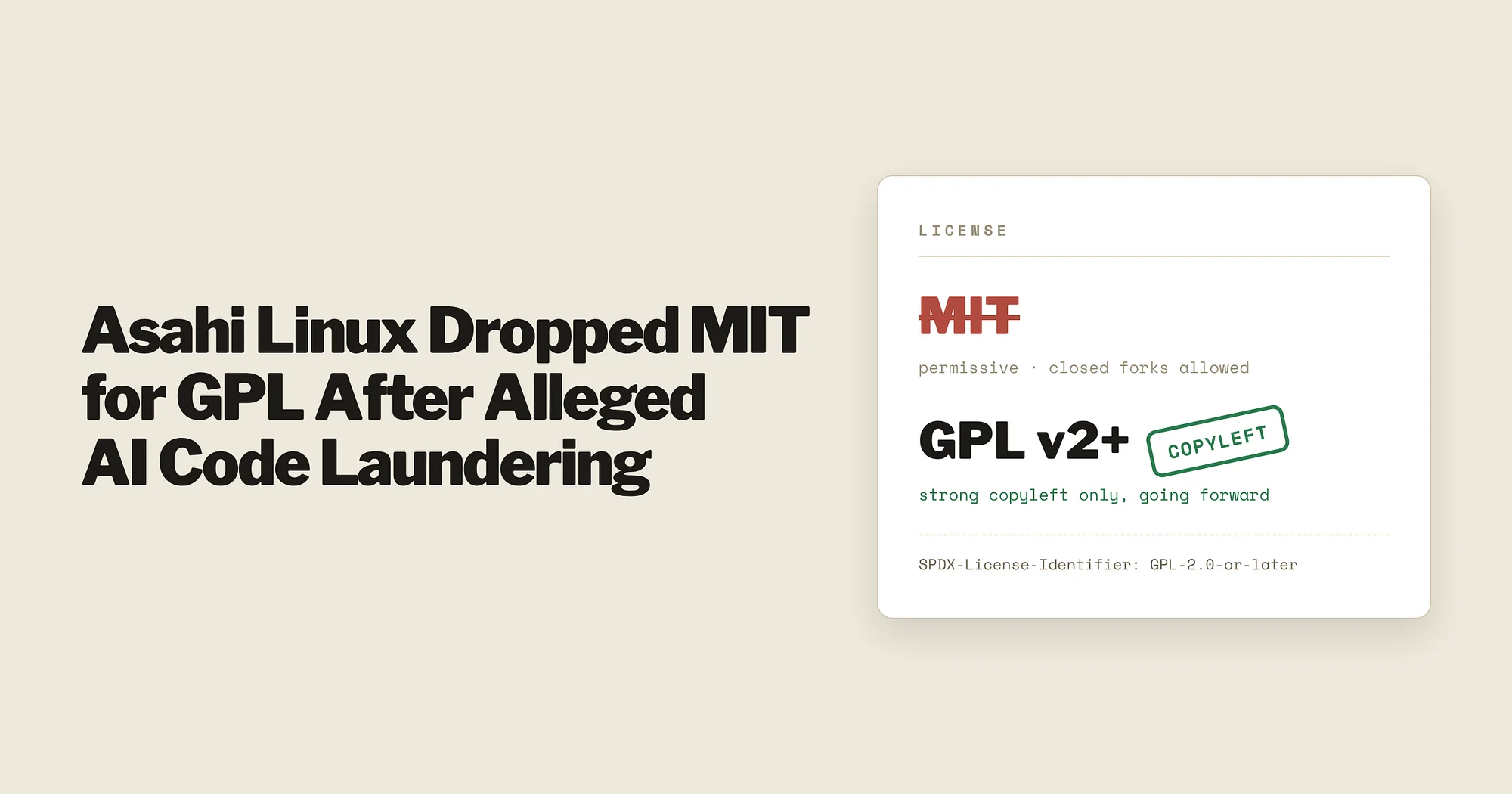
Asahi Linux Dropped MIT for GPL After Alleged AI Code Laundering
On November 7, 2026, Asahi Linux said it is moving every repository to GPL v2 or later. Asahi alleges that unreleased code was lifted from personal forks and that some of it was rewritten with LLM help to hide its origin. The report names no one, and the legal and community questions are still open.