Pump.fun Made $1 Billion Selling a Free Button. Most of the 24 Million Coins It Launched Were Dead Within a Day.
A Solana launchpad turned memecoin creation into a 1 click job, then charged a fee on every trade that followed. Here is who made money, who lost it, how presidents and celebrities copied the playbook, and why the platform keeps growing while the memecoin market shrinks.
Last verified
On this page
- Pump.fun gave away the coin and charged for the trading
- Most coins stop trading on the day they launch
- The people launching the coins take most of the profit
- Solana’s trading started to look like a casino floor
- The livestream feature showed how far people would go for attention
- Famous names ran the same playbook at a much bigger scale
- Hayden Davis explained the logic out loud
- Pump.fun’s own token followed the same curve
- The revenue comes from coins in their first hour
- A court and the market have both pushed back
- Pump.fun keeps growing while the market shrinks
- 2 things from this generalize
Pump.fun went live on Solana in January 2024, according to the court opinion in a class action against its operator. The idea was simple. Pick a name, a ticker and a picture, press a button, and you have a token anyone can trade. Today creating a coin costs nothing beyond a tiny network fee, according to Pump.fun’s own fee page. Since launch, people have pressed that button more than 24 million times, per a Sparsity analysis reported by Coinotag.
I want to walk through what that button did to crypto. How Pump.fun makes its money, what happens to the coins, who profits from a launch, how famous names ran the same play at a much bigger scale, and why the platform is still expanding after the memecoin market lost about 80% of its value. Every number below comes from an on chain analytics firm or a news outlet, and I name each one, because different trackers count things differently.
Pump.fun gave away the coin and charged for the trading
Pump.fun is run by Baton Corporation, a company registered in England, and was founded by Noah Tweedale, Alon Cohen and Dylan Kerler, who met in England, per WIRED’s profile and the federal court opinion in the class action against them. They are young. In a recent interview, Tweedale said he was 22, Cohen 23 and Kerler 24, according to TechFlow’s interview record. Tweedale told WIRED the original pitch was to put everyone on the same playing field, because buying memecoins had been unsafe and designed to drain buyers.
The business model is a toll on activity. Every buy and sell on a new coin’s bonding curve carries a 1.25% fee, with 0.95% going to the protocol and 0.30% to the coin’s creator, per Pump.fun’s fee page. A coin that nobody trades earns Pump.fun nothing. A coin that changes hands all afternoon earns it a fee every single time. Coins that attract enough buying “graduate” to PumpSwap, Pump.fun’s own exchange, where fees step down as a coin’s market value grows. The creator share has been tuned several times to pull launches onto the platform. In January 2026, Pump.fun let creators split their fees across up to 10 wallets and said creator fees needed a change, per MEXC News.
The toll has paid very well. Pump.fun earned $321.3 million in 2024 and $664 million in 2025, and in March 2026 it became the first Solana app to pass $1 billion in lifetime revenue, at about $1.08 billion, according to DefiLlama data reported by The Block. The platform spends nearly all of that revenue buying back its own PUMP token, a point I come back to below.
The peaks came early. In October 2024 the AI themed GOAT token, which started on Pump.fun, reached a $920 million market value, the highest of any Pump.fun coin at the time, The Block reported. Monthly revenue hit a record of more than $93 million in November 2024, per The Block, and daily fees peaked around $15.4 million in late January 2025 as Solana’s memecoin season topped out, according to Cointelegraph.
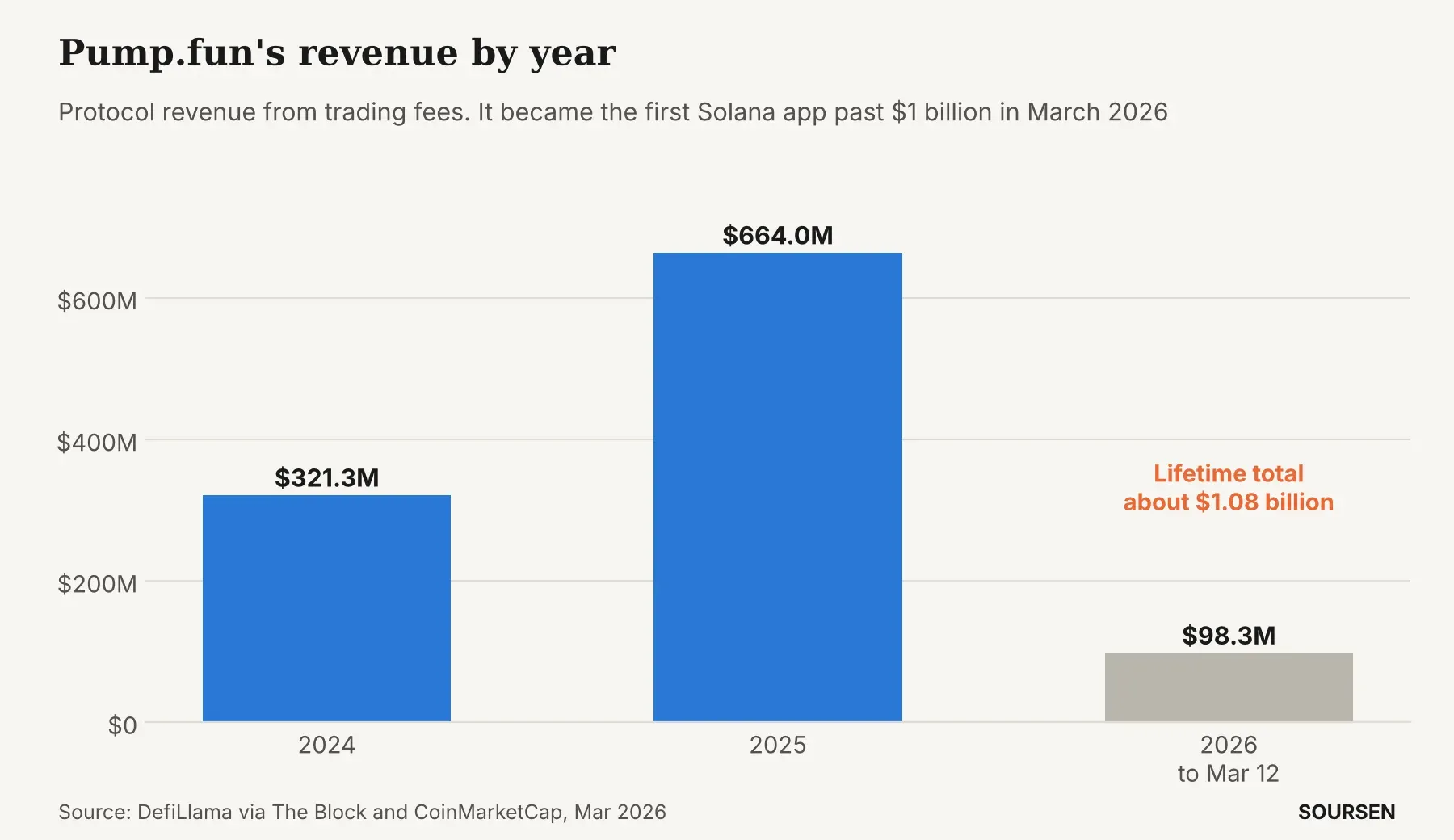
Pump.fun’s revenue by year. Protocol revenue from trading fees, with about $1.08 billion lifetime by March 2026. Source: DefiLlama via The Block and CoinMarketCap, March 2026.
Most coins stop trading on the day they launch
The best recent data comes from Bitquery, which tracked 11.5 million new Solana tokens from November 1, 2025 to October 7, 2026. Pump.fun made 78% of them, and its share of new launches rose from 65% in November to 90% in August, per Bitquery’s investigation. Of the 8.98 million Pump.fun tokens in its survival table, 79% never traded again after launch day. Half had their last trade within about 3 minutes. Only 1 in 58 graduated to a full trading pool, 1.5% still saw a trade in their fifth week, and 0.2% saw 10 or more trades that week.
CoinGecko ran a longer study and got a lower but still grim number. Of 18.67 million Pump.fun tokens created between January 2024 and June 2026, 68.67% recorded their last bonding curve trade on launch day, and 80.37% were done within 2 days, Crypto Briefing reported. The studies use different samples and periods, which explains the gap. Sparsity’s count is starker still. Of 24.4 million launches, only 312 kept a market value above $100,000.
Bitquery makes a fair point about what the 79% means. It measures how long people kept trading a coin, and says nothing about how much any buyer lost, as Cryptonews summarized. Still, a coin with no buyers after day 1 is worth whatever someone will pay, which is usually nothing.
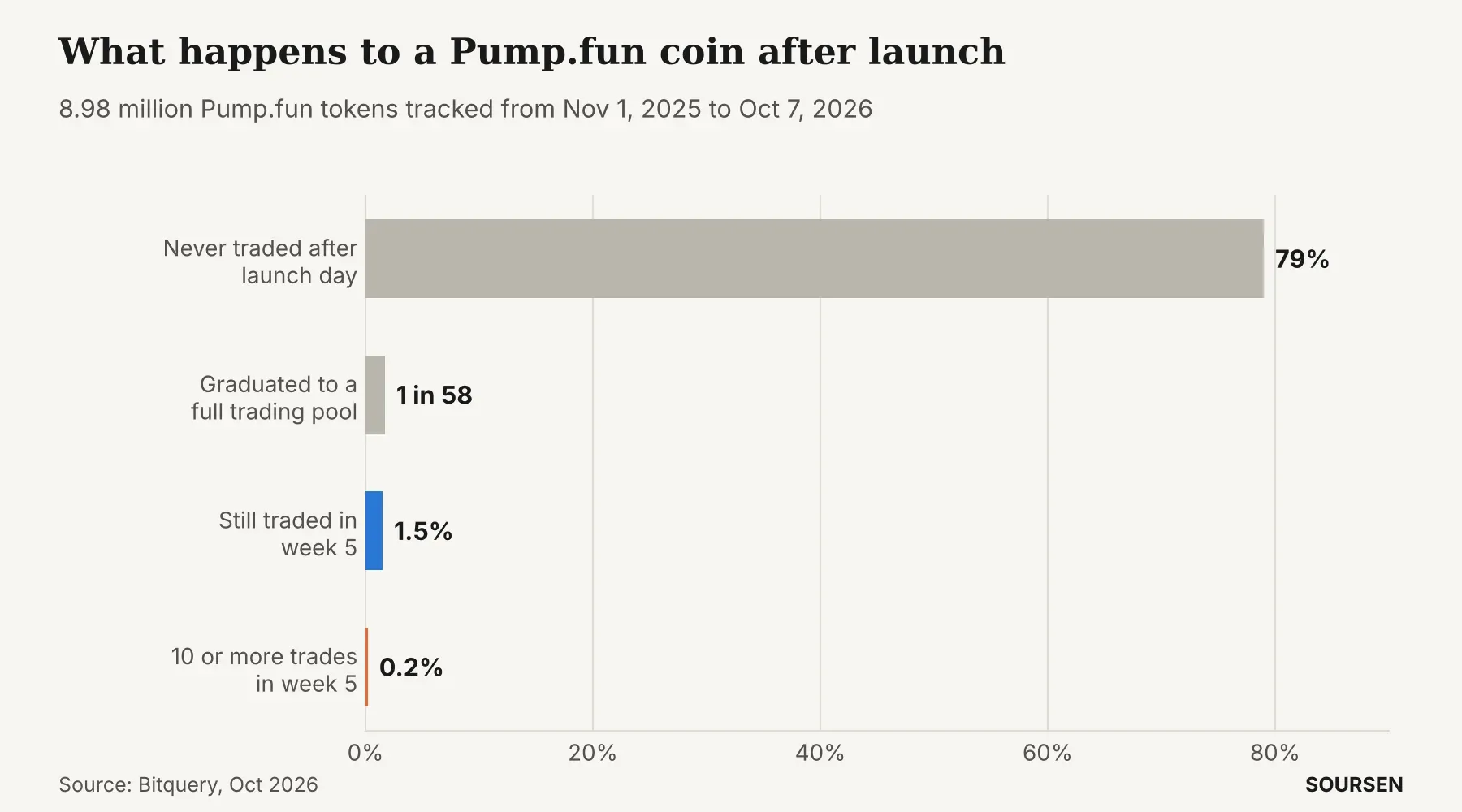
What happens to a Pump.fun coin after launch. 8.98 million Pump.fun tokens tracked from November 2025 to October 2026. Source: Bitquery, October 2026.
The people launching the coins take most of the profit
If most coins die by the next morning, who wins? Mostly the creators. A common tactic is the bundle, where a creator buys their own coin through several wallets in the same moment it launches. As outside buyers arrive and push the price up, those wallets sell into them. The late buyers end up paying the person who made the coin.
Bitquery added this up across roughly 8.2 million Pump.fun launches from October 2025 to October 7, 2026. For launches through the end of June 2026, developers and wallets tied to their launches made at least $579 million in profit after fees, according to Altcoin Buzz’s summary. Snipers, the fast traders who buy in the first seconds without being the creator, made about $31.5 million, so creators took roughly 18 times as much. The timing data is just as telling. Developer linked wallets bought in the launch block on 21% of launches, and developers made their first sale within 60 seconds on 65% of tokens and within a day on 90%.
Snipers are not always strangers either. Pine Analytics traced creators who funded sniper wallets directly before launch and found those wallets typically bought in the very first block, then sold 85% of the time within 5 minutes, BeInCrypto reported. Sandwich bots, which trade in front of and behind other people’s orders, took another $29.7 million before costs on Solana over 11 months, with 96% of detected attacks hitting Pump.fun or PumpSwap trades, per CryptoSlate. For ordinary traders, crypto.news reported that in March 2026 about 96% of Pump.fun wallets either lost money or made less than $500.
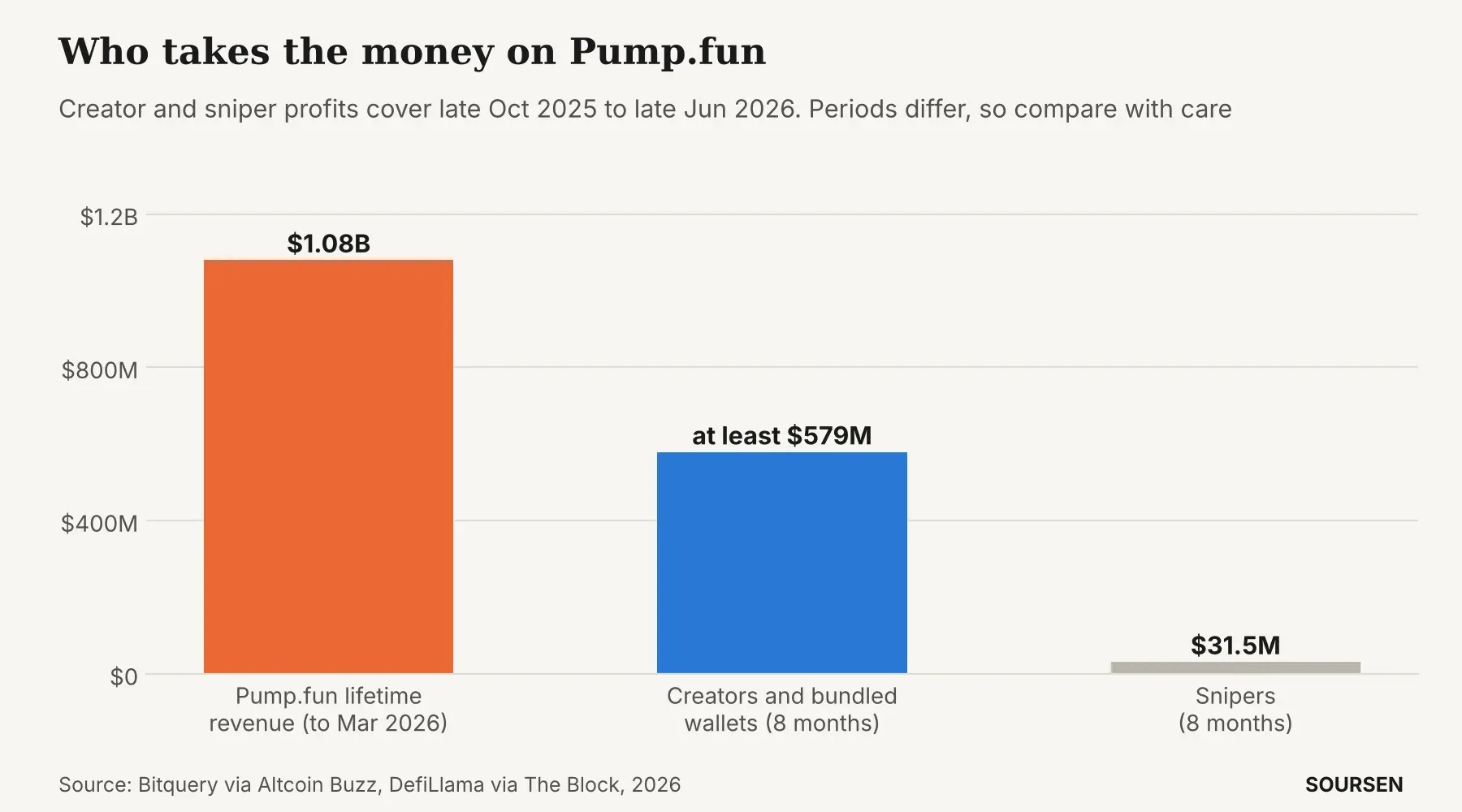
Who takes the money on Pump.fun. Creator and sniper profits cover late October 2025 to late June 2026, while revenue is lifetime. Source: Bitquery via Altcoin Buzz and DefiLlama via The Block, 2026.
Solana’s trading started to look like a casino floor
All that trading had to happen somewhere, and it happened on Solana. Memecoins made up 40% of Solana’s spot trading volume in the first half of 2025, according to 21Shares, and at the time 95% of the network’s revenue came from priority fees and MEV tips that rise with exactly this kind of bot heavy trading, per Solana Compass. By the first half of 2026 the memecoin share had fallen to 16%, and Solana’s gross revenue was down 87%.
Critics drew the casino comparison early. Ethereum co founder Vitalik Buterin grouped Pump.fun with Terra and FTX in April 2025 as examples of “bad social philosophy”, while praising Polymarket. Pump.fun’s founders argue the platform made launches more standardized and cut out the outright rug pulls that were common before it. Both things can be true. A standard launch format did not stop the creator from being the best placed seller.
The livestream feature showed how far people would go for attention
With tens of thousands of coins launching every day, getting noticed became the hard part. Pump.fun added livestreaming in May 2024 so creators could pitch their coin on camera. Some streams turned dangerous. Pump.fun suspended the feature on November 25, 2024 after users broadcast abuse, cruelty to animals and threats of self harm to pump token prices, The Block reported.
Revenue fell about 33% within days of the shutdown, per ForkLog. The pause lasted about 4 months. On April 4, 2025, Cohen announced livestreams were back for 5% of users with “industry standard moderation systems,” per Cointelegraph. A week later, on April 11, they were open to everyone, CryptoSlate reported. The new policy bans violence, harassment and sexual exploitation, and says it assumes plenty of not safe for work content will still appear.
Famous names ran the same playbook at a much bigger scale
An unknown creator needs stunts. A famous one only needs a post. The pattern showed up first with a stolen face. On August 29, 2024, hackers took over footballer Kylian Mbappé’s X account and promoted a token called MBAPPE, which was made on Pump.fun, per DailyCoin. One buyer spent about $1.03 million and watched the position fall to about $9,200 within an hour, according to Lookonchain data cited by crypto.news.
The celebrity coins that followed mostly launched elsewhere, but the mechanics matched. Hailey Welch’s HAWK token launched on December 4, 2024, hit a $490 million market value and then fell more than 90% within hours. Bubblemaps and Dexscreener data showed insider wallets and snipers controlled 80% to 90% of supply at launch, Cointelegraph reported. Welch denied that she or her team sold, and Bubblemaps later told Decrypt the team itself sold nothing while influencers and advisers did.
In January 2025, days before his second inauguration, Donald Trump launched the TRUMP memecoin. Entities connected to the Trump Organization, including Fight Fight Fight LLC, held 80% of the supply under a 3 year vesting schedule, per The Deep Dive. Chainalysis later found that of about 2 million wallets that bought it, 58 had made more than $10 million each, about $1.1 billion combined, while roughly 764,000 had lost money, NBC News reported. More than $324 million in trading fees went to wallets tied to the project. Wallets are not people, and one person can hold many. Ethics groups called the coin a conflict of interest, and the administration has denied any conflict, Benzinga noted. TRUMP peaked at $73.43 the day after launch and traded around $0.99 on November 14, 2026, per AirdropAlert.
Melania Trump’s MELANIA coin followed a day later. A Financial Times analysis found 24 wallets bought about $2.6 million of the token roughly 2.5 minutes before her announcement and later made close to $100 million, crypto.news reported. The wallet owners remain unknown.
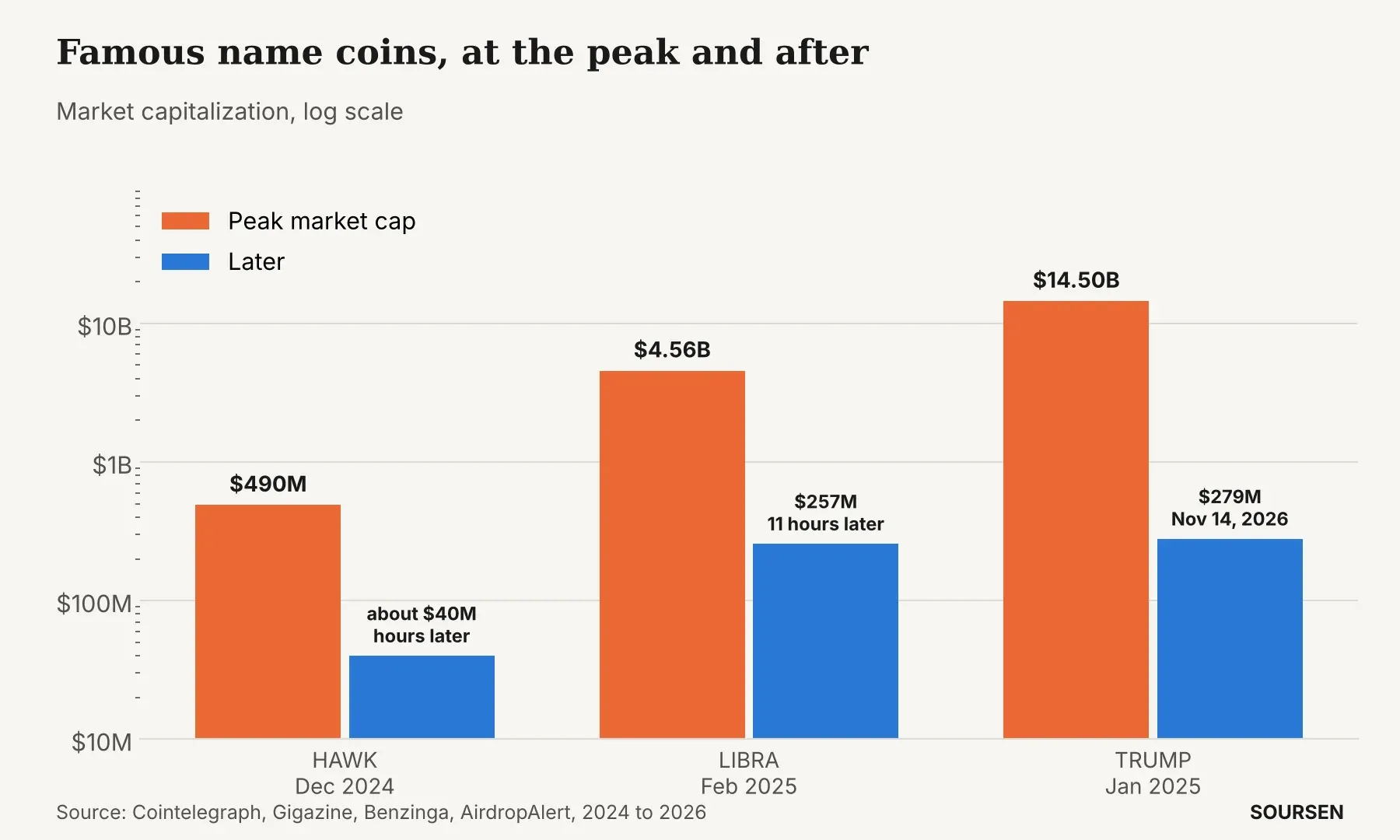
Famous name coins, at the peak and after. Market capitalization on a log scale. Source: Cointelegraph, Gigazine, Benzinga and AirdropAlert, 2024 to 2026.
Hayden Davis explained the logic out loud
Hayden Davis, CEO of Kelsier Ventures, told investigator Coffeezilla in February 2025 that he worked on MELANIA and that its team wanted to snipe the launch because of how big the TRUMP snipe had been, according to The Block. In the same interview he argued that in every memecoin he had known, the people who benefit are those who know about and structure the deal, per CoinDesk’s account.
Days earlier, on February 14, 2025, Argentine President Javier Milei had posted about a token called LIBRA, with its contract address. The token hit a peak market value of about $4.56 billion that evening, then fell about 94% within 11 hours, Cointelegraph reported. Estimates of what insiders pulled out vary. Bubblemaps counted $87.4 million in the first 3 hours, while Lookonchain counted $107 million across 8 wallets. Milei deleted the post and said he had not been aware of the details. Davis, who called himself the launch adviser, described the collapse as a plan gone wrong and acknowledged holding close to $100 million afterward, Al Jazeera reported.
The legal cases have ended without convictions so far. A New York federal court dismissed the LIBRA class action in September 2026. On October 23, Argentine federal judge Marcelo Martínez de Giorgi dismissed the criminal case against Milei, his sister Karina, Davis and 8 others at the prosecutor’s request, ruling the events did not fit any legal offense, The Block reported. Some investors are seeking to appeal.
By August 2025, all of this was public, and Kanye West’s YZY coin went the same way anyway. 70% of the supply went to Yeezy Investments LLC, and the price fell about 70% within hours of launch. Of 70,201 wallets that traded it, 51,862 lost money, $74.8 million in total, while 11 wallets made more than $1 million each, according to Bubblemaps data reported by The Block. Bubblemaps also said Davis made about $12 million sniping YZY, per ITC.
Pump.fun’s own token followed the same curve
In July 2025, Pump.fun launched its own token, PUMP. The public sale raised about $600 million in 12 minutes at $0.004 per token, valuing the project at $4 billion, Decrypt reported, and the total with private rounds came to about $1.3 billion, per Messari. Blockworks found one buyer had participated through 500 different addresses.
The sale also landed in the middle of Pump.fun’s first serious fight. On July 6, 2025, the rival launchpad LetsBONK passed Pump.fun in daily launches, graduations and volume for the first time, The Block reported. Pump.fun answered with buybacks and a new fee scheme for creators, and within about 2 weeks in August its share of graduated launches swung from as low as 5% to 90%, as LetsBONK fell to 3%, according to The Block. The Block noted that top deployers and bots moving back may have mattered as much as the buybacks. Bots go wherever the economics are best, and they move fast.
PUMP fell below its sale price within about a week. Pump.fun has since spent roughly $350 million buying back its own token, yet PUMP recently traded near $0.00165, about 81% below its September 2025 high, BeInCrypto reported. So even buyers of Pump.fun’s own coin have mostly lost money, while the platform’s revenue kept coming.
The revenue comes from coins in their first hour
Sparsity’s analysis shows where the money comes from. Between September 2, 2025 and November 5, 2026, 95% of Pump.fun’s protocol revenue came from tokens still on the bonding curve or worth less than $250,000, 75% came from tokens under an hour old, and 87% from tokens under a day old, according to ChainCatcher.
Put that next to Bitquery’s 79%, and the picture is clear. For Pump.fun, coins dying after day 1 costs nothing, because the first day is when the trading happens, and trading is what the platform charges for. Like the house in a casino, it takes a cut of every hand whether the player wins or loses. That is my reading of the numbers. Pump.fun describes itself as a neutral launch tool and has said it built the platform to make launches fairer.
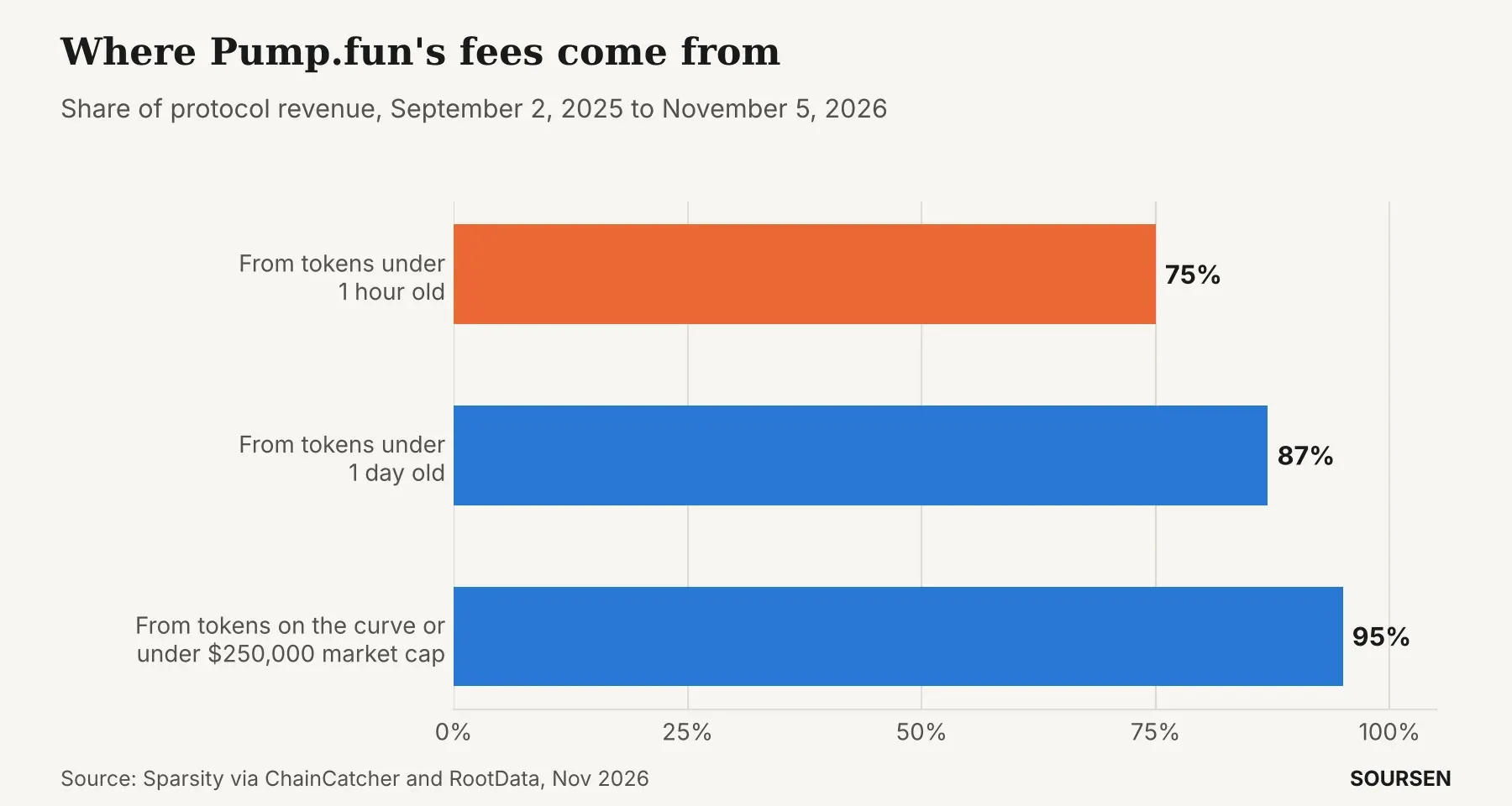
Where Pump.fun’s fees come from. Share of protocol revenue by token age and size. Source: Sparsity via ChainCatcher, November 2026.
A court and the market have both pushed back
The first challenge is legal. The case began in January 2025 as a suit by buyers of PNUT, a memecoin the complaint says was issued through Pump.fun, per Stanford’s Securities Class Action Clearinghouse, and grew into a consolidated class action brought by Burwick Law. In Aguilar v. Baton Corporation, a class action in the Southern District of New York, Judge Colleen McMahon ruled on August 31, 2026 that racketeering claims alleging wire fraud, illegal gambling and unlicensed money transmission can proceed against Baton Corporation and all 3 founders, Protos reported. The same order dismissed the securities claims and every claim against Solana Labs, the Solana Foundation and their executives, per Solana Compass. These are allegations, and nothing has been proven in court. The same plaintiffs also named 25 crypto influencers they have struggled to locate, The Currency Analytics reported.
The second is the market. Total memecoin market value peaked at $150.6 billion in December 2024, per CoinGecko, and fell to about $31 billion by March 2026, NewsBTC reported via KuCoin. That is roughly 80% gone in about 15 months. Pump.fun felt it too. By June 2026, its graduation rate had fallen to a 7 day average of 0.26%, an 80% drop in 3 months, as traders moved to perpetual futures, The Block reported.
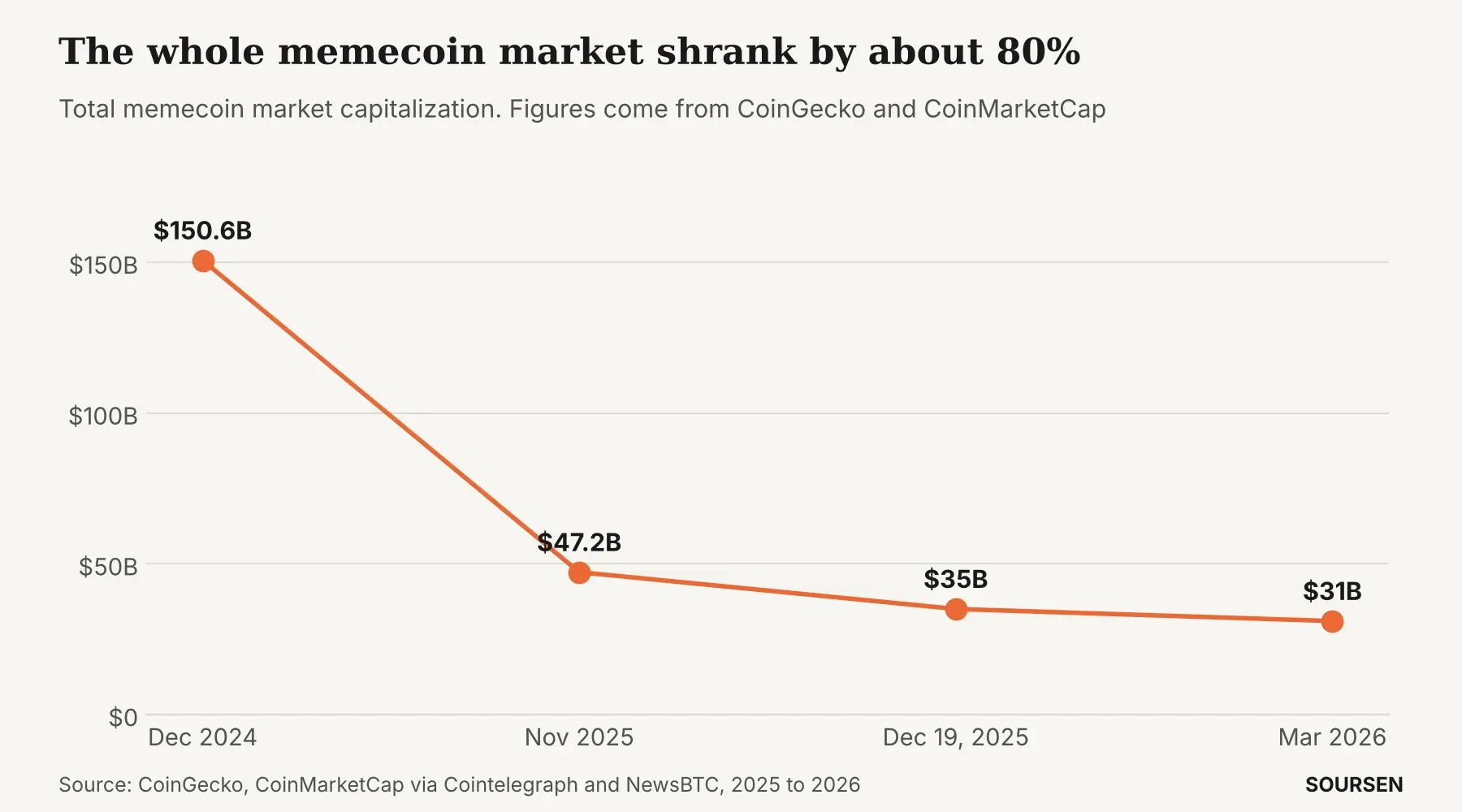
The whole memecoin market shrank by about 80%. Total memecoin market capitalization. Source: CoinGecko and CoinMarketCap via Cointelegraph and NewsBTC, 2025 to 2026.
Pump.fun keeps growing while the market shrinks
You would expect the platform that fed the memecoin boom to shrink with it. It has not. Over the 30 days to early November 2026, Pump.fun accounted for 92% of memecoin launches across all chains and 84% of trading volume in the launch segment, per Sparsity via Coinotag. It still pulled in about $1.98 million in daily revenue on October 24, briefly passing Hyperliquid, according to Altcoin Buzz.
It is also branching out. On November 16, 2026, Pump.fun added Polymarket prediction markets to its mobile app for users in permitted jurisdictions, alongside memecoins and perpetual futures, Solana Compass reported. Tweedale has compared Pump.fun’s ambitions to Coinbase and said its foundation treasury holds close to $2 billion, per TechFlow. Domain records also show Pump.fun subdomains for Ethereum, Base, BNB Chain and Monad, which The Block read as a sign of plans beyond Solana.
2 things from this generalize
The first is that the business model tells you who the product serves. When a platform earns a fee on every trade and most of its revenue comes from coins under an hour old, its incentives point toward more launches and faster trading. Whether any single coin survives does not affect its income.
The second is that famous names make the same mechanics more expensive. TRUMP, MELANIA, LIBRA, HAWK and YZY all showed early insiders or snipers with an edge over everyone who bought after the announcement, and the on chain data in each case shows a small group of big winners and a large group of losers.
This week, before you buy any new token, open a free holder map such as Bubblemaps for its contract address and check what share of supply sits with the top 10 wallets and whether they were funded by the creator. If the answer is most of it, you already know who you would be buying from.
Sources
- Pump.fun, Transaction fees on Pump.funintercom.help. Accessed 23 November 2026.
- Coinotag, Sparsity report on Pump.fun revenueen.coinotag.com. Accessed 23 November 2026.
- WIRED, The madcap rise of memecoin factory Pump.Funwirednews.pages.dev. Accessed 23 November 2026.
- CourtListener, Aguilar v. Baton Corporation opinionstorage.courtlistener.com. Accessed 23 November 2026.
- TechFlow, Interview with Noah Tweedaletechflowpost.com. Accessed 23 November 2026.
- The Block, Pump.fun becomes Solana's first $1B revenue platformtheblock.co. Accessed 23 November 2026.
- Bitquery, 1 in 58 Pump.fun coins graduate, 79% die after day onebitquery.io. Accessed 23 November 2026.
- Crypto Briefing, CoinGecko Pump.fun token survival studycryptobriefing.com. Accessed 23 November 2026.
- Cryptonews, Bitquery finds 79% of Pump.fun tokens traded only on launch daycryptonews.net. Accessed 23 November 2026.
- Altcoin Buzz, Pump.fun revenue and developer profitsaltcoinbuzz.io. Accessed 23 November 2026.
- BeInCrypto, How snipers on Pump.fun manipulate marketsbeincrypto.com. Accessed 23 November 2026.
- CryptoSlate, Solana sandwich bots took $29.7 millioncryptoslate.com. Accessed 23 November 2026.
- Solana Compass, 21Shares on Solana's H1 2026 revenuesolanacompass.com. Accessed 23 November 2026.
- nft now, The Pump.fun debatenftnow.com. Accessed 23 November 2026.
- The Block, Pump.fun reopens livestreaming to 5% of userstheblock.co. Accessed 23 November 2026.
- Cointelegraph, Pump.fun brings livestream feature backcointelegraph.com. Accessed 23 November 2026.
- CryptoSlate, Pump.fun fully restores streamingcryptoslate.com. Accessed 23 November 2026.
- DailyCoin, MBAPPE investor loses $1M in one hourdailycoin.com. Accessed 23 November 2026.
- crypto.news, Mbappé's X account hackedcrypto.news. Accessed 23 November 2026.
- Cointelegraph, Hawk Tuah memecoin dumps 90%cointelegraph.com. Accessed 23 November 2026.
- The Deep Dive, Most Trump meme coin investors face lossesthedeepdive.ca. Accessed 23 November 2026.
- NBC News, 58 wallets made millions on Trump's meme coinnbcnews.com. Accessed 23 November 2026.
- Benzinga, 764,000 wallets have lost money on Trump's memecoinbenzinga.com. Accessed 23 November 2026.
- AirdropAlert, TRUMP under $1airdropalert.com. Accessed 23 November 2026.
- crypto.news, Traders made $100M buying MELANIA before launchcrypto.news. Accessed 23 November 2026.
- The Block, Hayden Davis admits team sniped token at launchtheblock.co. Accessed 23 November 2026.
- CoinDesk via Coinspectator, LIBRA creator says he sniped both tokenscoinspectator.com. Accessed 23 November 2026.
- Cointelegraph, Milei LIBRA token scandalcointelegraph.com. Accessed 23 November 2026.
- Al Jazeera, Argentinian judge drops fraud investigation into Mileialjazeera.com. Accessed 23 November 2026.
- The Block, Argentine judge clears Milei and 10 others in LIBRA casetheblock.co. Accessed 23 November 2026.
- The Block, YZY crash leaves over 50,000 wallets with lossestheblock.co. Accessed 23 November 2026.
- ITC, Thousands of YZY buyers left with lossesitc.ua. Accessed 23 November 2026.
- Decrypt, Pump.fun's token falls below ICO pricedecrypt.co. Accessed 23 November 2026.
- Messari, Pump.funmessari.io. Accessed 23 November 2026.
- BeInCrypto via TradingView, $350 million PUMP buybacks fail to lift pricetradingview.com. Accessed 23 November 2026.
- ChainCatcher, Pump.fun revenue concentrationchaincatcher.com. Accessed 23 November 2026.
- Protos, RICO allegations against Pump Fun upheldprotos.com. Accessed 23 November 2026.
- Solana Compass, Judge clears Solana Labs and Foundationsolanacompass.com. Accessed 23 November 2026.
- KuCoin, Memecoin market cap drops from $150B to $31Bkucoin.com. Accessed 23 November 2026.
- Cointelegraph, Memecoins fall 65% in 2025cointelegraph.com. Accessed 23 November 2026.
- Solana Compass, Pump.fun adds Polymarket prediction marketssolanacompass.com. Accessed 23 November 2026.
- crypto.news, Pump.fun's token factory has a 69% launch day death ratecrypto.news. Accessed 23 November 2026.
- The Block, Pump.fun hits record revenue amid AI and memecoin frenzytheblock.co. Accessed 23 November 2026.
- The Block, Pump.fun reaches monthly revenue peak with $93 milliontheblock.co. Accessed 23 November 2026.
- Cointelegraph, How Pump.fun captured 80% of Solana memecoinscointelegraph.com. Accessed 23 November 2026.
- ForkLog, Pump.fun revives streaming featureforklog.com. Accessed 23 November 2026.
- Blockworks, Pump.fun's ICO flooded by coordinated wallet participationblockworks.com. Accessed 23 November 2026.
- The Block, LetsBONK dethrones Pump.funtheblock.co. Accessed 23 November 2026.
- The Block, Launchpad war flips again as Pump takes top spottheblock.co. Accessed 23 November 2026.
- MEXC News, Pump.fun overhauls creator feesmexc.com. Accessed 23 November 2026.
- The Block, Pump.fun activity craters 80% in three monthstheblock.co. Accessed 23 November 2026.
- Stanford Securities Class Action Clearinghouse, PNUT case filingsecurities.stanford.edu. Accessed 23 November 2026.
- The Currency Analytics, Baton Corporation faces RICO chargesthecurrencyanalytics.com. Accessed 23 November 2026.
Related stories
More in Crypto
Crypto & markets
Richard Heart Beat the SEC on a Technicality, Then His Own Tax Office Caught Up With Him in…
On 14 October 2026, Turkish police arrested the founder of Hex and PulseChain on an Interpol red notice issued for Finland, which suspects him of gross tax evasion. He had walked away from a $1 billion SEC case 18 months earlier, not because a court cleared him, but because the judge found no US jurisdiction. I went through the whole arc, the sacrifice mechanism, the allegations, the dismissal that was not an acquittal, and a blockchain whose biggest customer was its own founder.
Crypto & markets
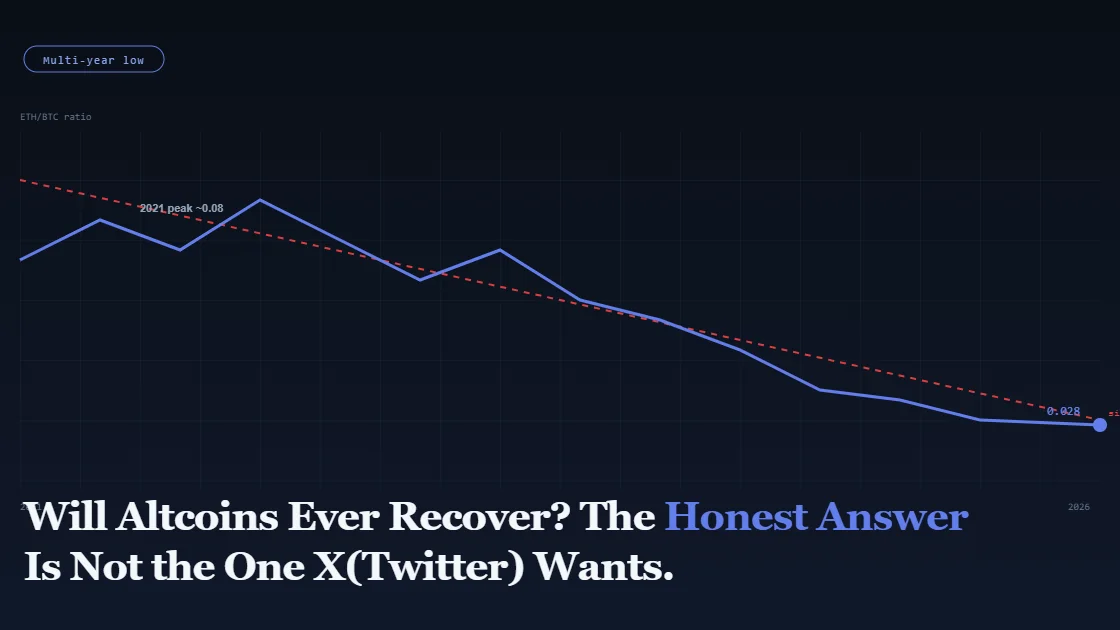
Will Altcoins Ever Recover? The Honest Answer Is Not the One X(Twitter) Wants.
Note: This article is for informational purposes only and does not constitute financial or investment advice.
Crypto & markets
7 Crypto Mistakes That Could Wipe Out Your Portfolio in 2026
Note: This article is for informational purposes only and does not constitute financial or legal advice.