Just Read the Code, Bro. 9 Linux Takes That Fall Apart When You Check the Numbers
Starter distros, lazy developers, fragmentation, donation guilt and the old claim that open source is less secure. I checked each one against 2026 data, and most of them do not survive.
Last verified

On this page
- There is no such thing as a starter distro
- “Just read the PKGBUILD” is a security policy for nobody
- Free software was political from its first announcement
- Linux is ready for the desktop, and the share numbers need careful reading
- AI helps Linux run more software and buries maintainers in junk at the same time
- Calling volunteers lazy ignores who actually writes the code
- Fragmentation looks scary until you count the distros people actually use
- Asking for money is how free software stays free
- Open source gets more eyes on its code, and in 2026 many of those eyes are AI models
- 2 things from this generalize
The Linux crowd has opinions. I like that about it. A community that argues about init systems at 2am is a community that cares. The downside is that some takes get repeated so often that nobody checks them anymore, and a few of them are plain wrong.
I want to walk through 9 of the most common ones, from “you will outgrow Ubuntu” to “open source is less secure than Windows,” and test each against what the data says in November 2026. Some contain a small grain of truth. Most collapse once you look at market share figures, kernel development reports, maintainer surveys and the AI security research that landed this year.
There is no such thing as a starter distro
The idea goes like this. You begin on Ubuntu, Linux Mint or Zorin OS. You learn the ropes. Then, once you are enlightened, you graduate to Arch, Gentoo or Linux From Scratch, and the beginner distro becomes something you used once, like training wheels.
I think this gets distros backwards. A distro is a set of defaults, a release cadence and a package manager. Easy defaults do not expire when you learn more. Plenty of people who could compile their own kernel run Mint because they want their laptop to work on Monday morning.
The numbers back this up. In Valve’s October 2026 Steam Hardware and Software Survey, which skews toward enthusiasts who game, Linux Mint 22.3 sat at 8.41% of Linux systems, within 0.51 points of Arch Linux at 8.92%, according to the breakdown reported by GamingOnLinux and ComputingForGeeks. That is a crowd of experienced users, and a “starter” distro is in their top 4. A year earlier, in the October 2025 survey, Arch held 10.32%, Linux Mint 22.2 had 6.65% and CachyOS had 6.01%, according to KitGuru. People do move around. CachyOS, an Arch based distro tuned for performance, nearly tripled its share in 12 months. Mint’s newest release also holds more share than its predecessor did a year ago, which tells me plenty of people who could switch to something harder choose to stay.
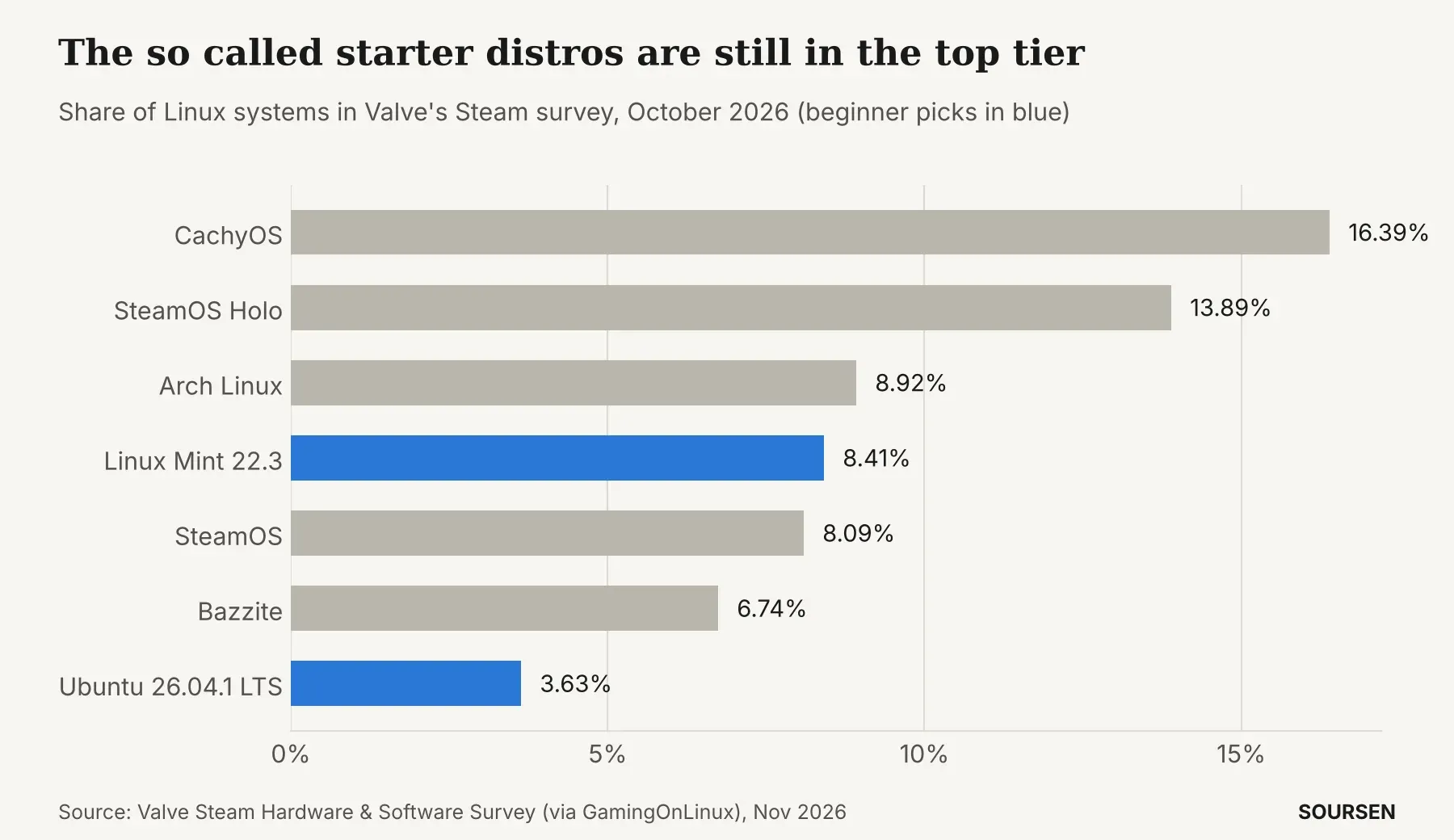
The so called starter distros are still in the top tier. Linux distribution share among Linux systems in Valve’s Steam survey. Source: Valve via GamingOnLinux, November 2026.
Windows offers a useful comparison. Plenty of people buy a laptop with Windows Home and use it until the hinge breaks without ever moving to a Pro edition. Nobody calls them baby Windows users. The same logic applies here. If Ubuntu has worked for you since 2019, you are a Linux user who found the right tool. Distro hopping is a hobby, and it is fine as a hobby. It is no rite of passage.
“Just read the PKGBUILD” is a security policy for nobody
This one shows up whenever someone asks whether a package from the Arch User Repository is safe. The answer is often some version of “read the build script and you will know.” The same advice gets stretched to whole projects. If you cannot audit the code, the argument goes, you should not run it.
Most people cannot read a shell script well enough to spot obfuscated malware. Many experienced users cannot either. The AUR proved this in July 2025. On July 16, an account called danikpapas uploaded 3 packages named librewolf-fix-bin, firefox-patch-bin and zen-browser-patched-bin. According to the Arch Linux security notice and It’s FOSS, the packages pulled a script from GitHub that installed CHAOS RAT, a remote access trojan. They stayed up for about 2 days before Arch maintainers removed them on July 18. The French tech blog Korben reported that 3 more suspicious packages were pulled in the same cleanup, including ones posing as a cracked Minecraft and a Microsoft fonts bundle, all carrying the same trojan. The official Arch notice names only the first 3, so treat the larger count as one outlet’s report.
Look at how they were caught. Reddit users found a long dormant account promoting the packages, uploaded a component to VirusTotal and saw the detection, as Daily Security Review reported. Community vigilance caught them. Anyone who installed during those 48 hours was already exposed, and The Register noted that for non technical users the safest cleanup was a full wipe and reinstall. A few weeks later the AUR saw another RAT incident.
I think the lesson is clear. If an install channel depends on every user auditing code, that channel has a security gap, and it should not be the first place you send newcomers. Asking a normal person to review a PKGBUILD before installing a browser is like asking them to run a penetration test before plugging in a router.
Trust has to come from somewhere, and good systems make it visible. Flathub marks apps with a blue check when the developer has proved ownership of the app ID, usually through a token placed on their own domain, as its verification documentation explains. Since 2024 Flathub has also flagged unverified apps as community maintained, and it says a human reviews every submission. Flathub describes its model as layers of protection that include sandboxing, permission limits that submitters must justify during review, automated checks and that verification badge. A badge tells you who shipped the app, which tells you who to hold responsible. Code quality is a separate question. As a starting point it beats “read the script, bro” by a mile.
Free software was political from its first announcement
“Keep politics out of my Linux” is a popular complaint. I understand the impulse. Nobody wants a package manager with a party affiliation. The word political means something wider here, though. It means a choice about how society works, who owns tools and who gets to change them.
By that definition free software has always been political. Richard Stallman posted the initial announcement of the GNU Project on September 27, 1983, and work began in January 1984. The goal was to build enough free software that people could live without proprietary programs. The Free Software Foundation still explains the idea as freedom first, with price a separate question, in its essay on selling free software. Copyleft licenses like the GPL add rules so that a company cannot take shared code, close it and walk away.
Linux itself started with smaller ambitions. On August 25, 1991, Linus Torvalds told the comp.os.minix newsgroup his project was “just a hobby, won’t be big and professional like gnu,” as preserved on the kernel mailing list archive. The politics arrived as a side effect. Today a lot of people install Linux to get away from forced updates, telemetry, locked ecosystems and subscription upsells. That is a group of users making a shared choice because they dislike the status quo, and that is politics in the plain sense.
“Keep politics out” usually shows up when someone dislikes a specific position a project took. Rejecting that position is also a political stance. You can hold it, and many people do. Calling it neutral is where the take falls apart.
Linux is ready for the desktop, and the share numbers need careful reading
“Linux will never be ready, it is a toy for geeks” is the take I find hardest to defend in 2026. Valve sells a Linux console PC. The Steam Machine launched at the end of June 2026 at $1,049 for the 512GB model and $1,349 for 2TB, running SteamOS. Android, built on the Linux kernel, held 36.15% of web page views across all platforms in June 2026 according to StatCounter. KDE Plasma and GNOME ship polished desktops, and in January 2026 a developer known as PhialsBasement published Wine patches that let the Adobe Photoshop 2021 and 2025 installers run on Linux. Those patches landed in Wine-Staging 11.1 a week later.
Windows 10 also gave Linux a push. Microsoft ended support for most Windows 10 editions on October 14, 2025, and a coalition led by KDE contributors, along with groups like GNOME, openSUSE, FSFE and Repair Cafés, ran the End of 10 campaign to help people put Linux on PCs that cannot run Windows 11. A KDE conference talk on the campaign cited a Canalys estimate that the cutoff could turn 240 million PCs into electronic waste.
Desktop share is where I have to be careful, because the headline numbers this year were wild. StatCounter showed Linux at 7.53% of desktops worldwide in July 2026 and 10.65% in North America, as GamingOnLinux reported. StatCounter later restated the North American figure to 10.61%, according to Cybernews. PCWorld argued that AI bots running on Linux inflated those figures. StatCounter’s US number then swung from 11.87% in July to 3.69% in September before settling at 5.57% in October, per the TechnologyChecker analysis.
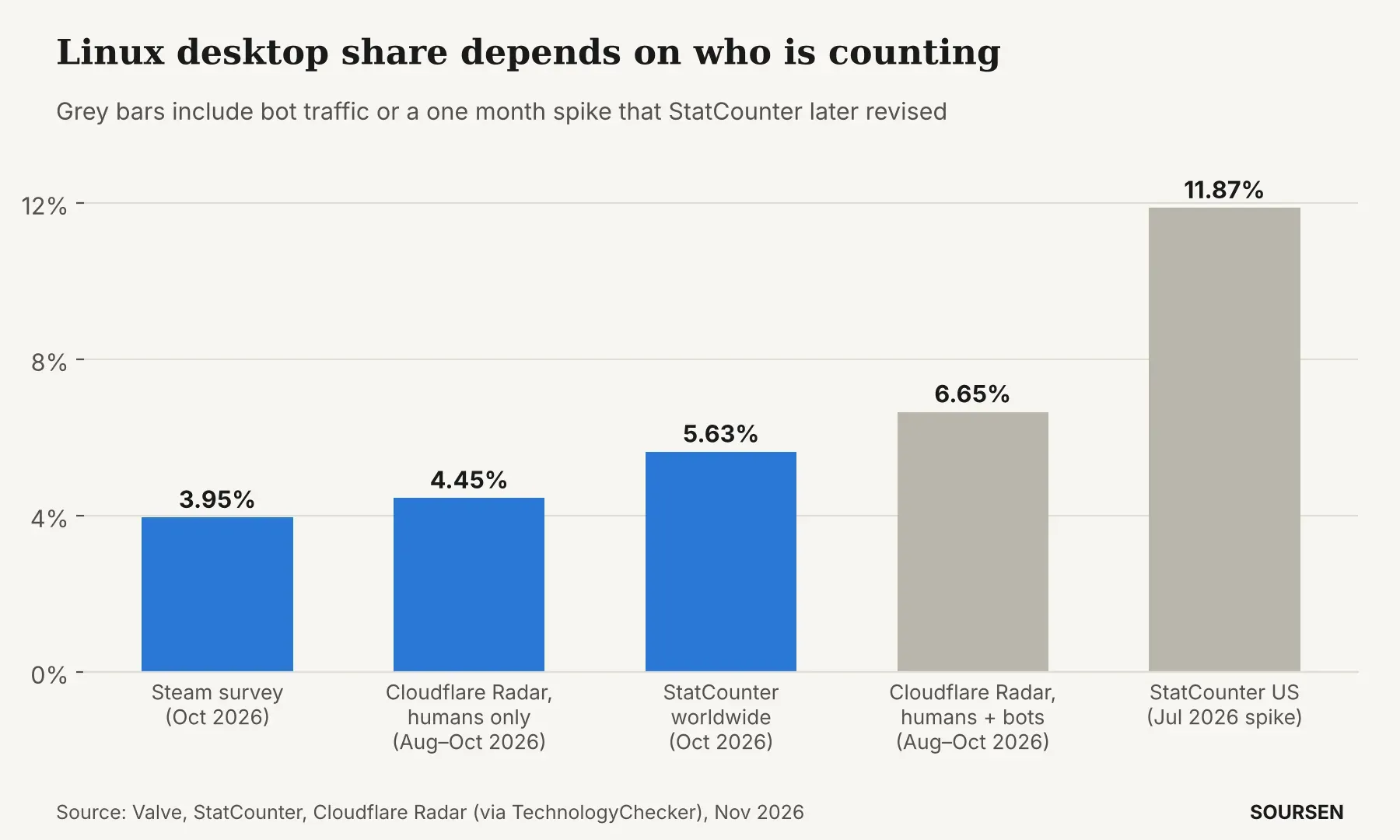
Linux desktop share depends on who is counting. Grey bars include bot traffic or a revised spike. Source: Valve, StatCounter and Cloudflare Radar via TechnologyChecker, November 2026.
The cleanest number I found filters out bots. An analysis of Cloudflare Radar data by TechnologyChecker puts Linux at 4.45% of human desktop web requests from August to October 2026, up from 3.22% a year earlier. Bots made up 52.31% of Linux desktop requests in that window, which explains why unfiltered figures run so high. The same human filtered data shows the United States at 7.11%, Germany at 5.76% and India at 5.34%. Steam tells a similar story from a different angle. Linux reached 3.95% of Steam users in October 2026, up from 3.05% in October 2025, according to Phoronix, after a spike to 5.33% in March that many observers doubted.
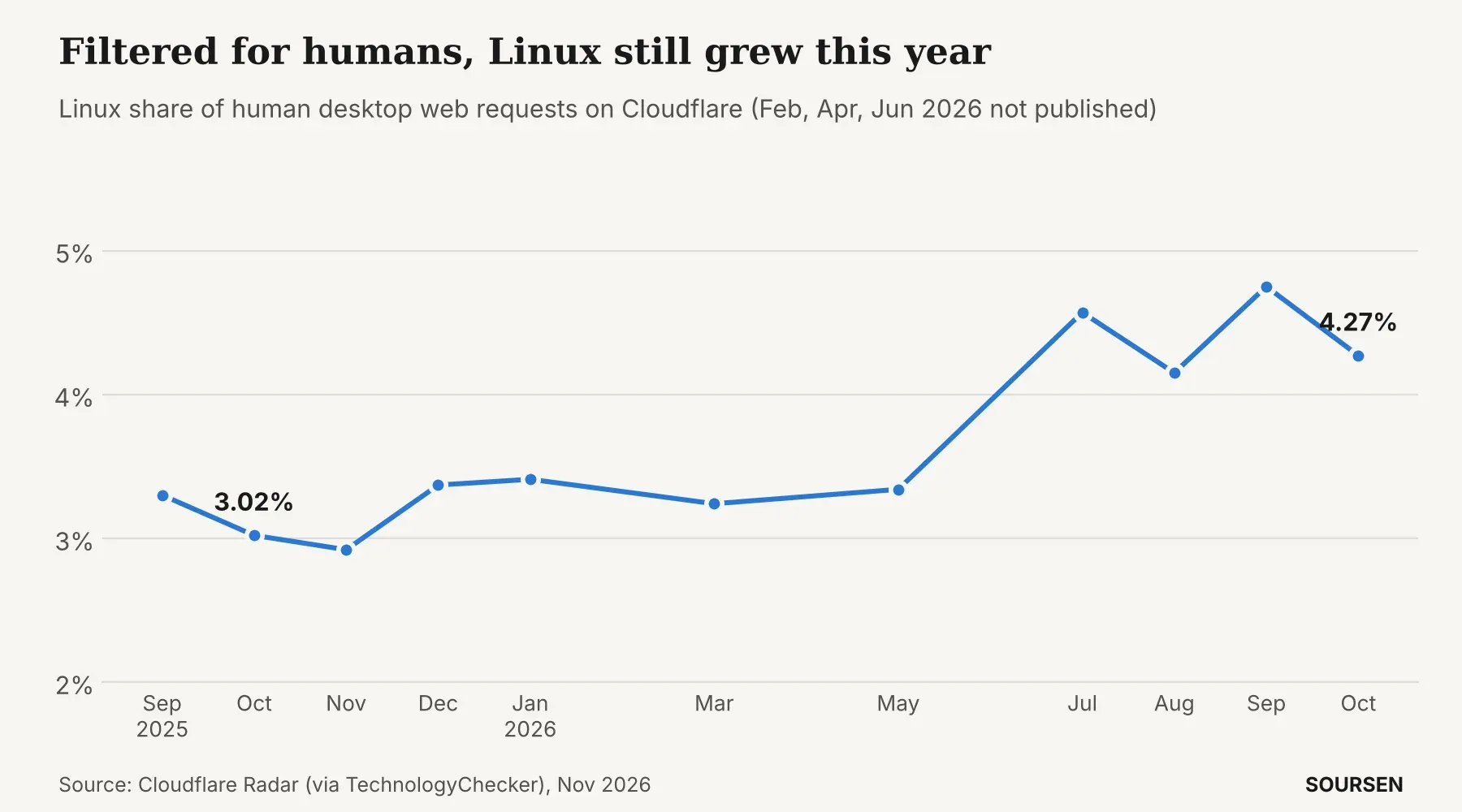
Filtered for humans, Linux still grew this year. Linux share of human desktop web requests on Cloudflare. Source: Cloudflare Radar via TechnologyChecker, November 2026.
Walk into a room of 100 desktop users in late 2026 and roughly 4 of them run Linux, give or take, depending on the country and the dataset. That is small. It is also the highest it has been on human filtered data in that series, and it grew by about 38% in a year.
AI helps Linux run more software and buries maintainers in junk at the same time
There is a hopeful take going around that AI coding tools will end proprietary lock in. The logic is that if models can write compatibility patches and clone apps, every Windows program will eventually run on Linux and nobody will need to pay Adobe or Microsoft again.
Part of this is already visible. When OMG! Ubuntu covered the Photoshop installer patches, it said the work involved trial and error plus a pinch of vibe coding. AI assisted compatibility work is happening.
The leap to “proprietary software disappears” is where it goes too far. Companies pay for Microsoft 365, AutoCAD and Creative Cloud for support contracts, compliance certifications, file fidelity and a vendor to call at 3am. A clone that works 95% of the time does not replace those, even if it is free. Proprietary desktop software will keep a market for a long time.
The other side of AI deserves equal attention. curl creator Daniel Stenberg ended the project’s bug bounty at the end of January 2026, saying he wanted to remove the incentive to submit low quality reports, as The Register reported. The totals depend on who you read. Bugcrowd’s summary says the program ran 6 years, paid $86,000 and fixed 78 confirmed vulnerabilities. Stenberg himself wrote in mid 2025 that it had produced 81 genuine security problems and over $90,000 in awards, and The Stack quoted him at roughly 87 vulnerabilities and over $100,000. Bugcrowd also put AI slop at roughly 20% of submissions by mid 2025. Stenberg has also said he knows of more than 100 good AI assisted reports that led to fixes, as Michael Tsai’s roundup of his comments notes. Both things are true. AI is a useful tool in skilled hands and a spam cannon in careless ones, and open source maintainers absorb the cost of the second group.
The kernel drew its own line in August 2026. Greg Kroah-Hartman, who uses AI tools in his own kernel work, said the drivers/staging tree would reject LLM generated patches unless they fix a genuine security issue tested on hardware, as Phoronix reported. Staging exists so newcomers can learn on simple cleanups, and an AI doing those cleanups defeats the point. He also said, per Linux Magazine, that “at least 1/3 of the results they generate are flat out wrong or harmful.”
Calling volunteers lazy ignores who actually writes the code
“Why don’t the GNOME devs just fix it? Lazy.” “Why isn’t LibreOffice 100% compatible with Word yet? Lazy.” I see some version of this every week. The people being called lazy build the Linux kernel, Blender, Inkscape, Krita, LibreOffice, KDE, GNOME and Mesa, software that competes with products backed by some of the richest companies on earth.
The funding picture depends on the project. The kernel is mostly paid work. The Linux Foundation’s development reports found that more than 80% of kernel changes came from developers paid for the work by 2015, and the unpaid share fell from 14.6% in the 2012 report to 7.7% in 2016, with a small rise to 8.2% in 2017. The long tail of smaller projects looks different. In Tidelift’s 2024 maintainer survey of over 400 maintainers, 60% described themselves as unpaid hobbyists, and Socket’s write up of the same data found 61% of unpaid maintainers reported maintaining their projects alone. Governments have started to notice. Germany’s Sovereign Tech Fund had put over €24.6 million into more than 60 open source projects, and in May 2026 it committed more than €1 million to KDE for security and core infrastructure work. That is meaningful money for the projects that get it, and most maintainers will never see a grant.
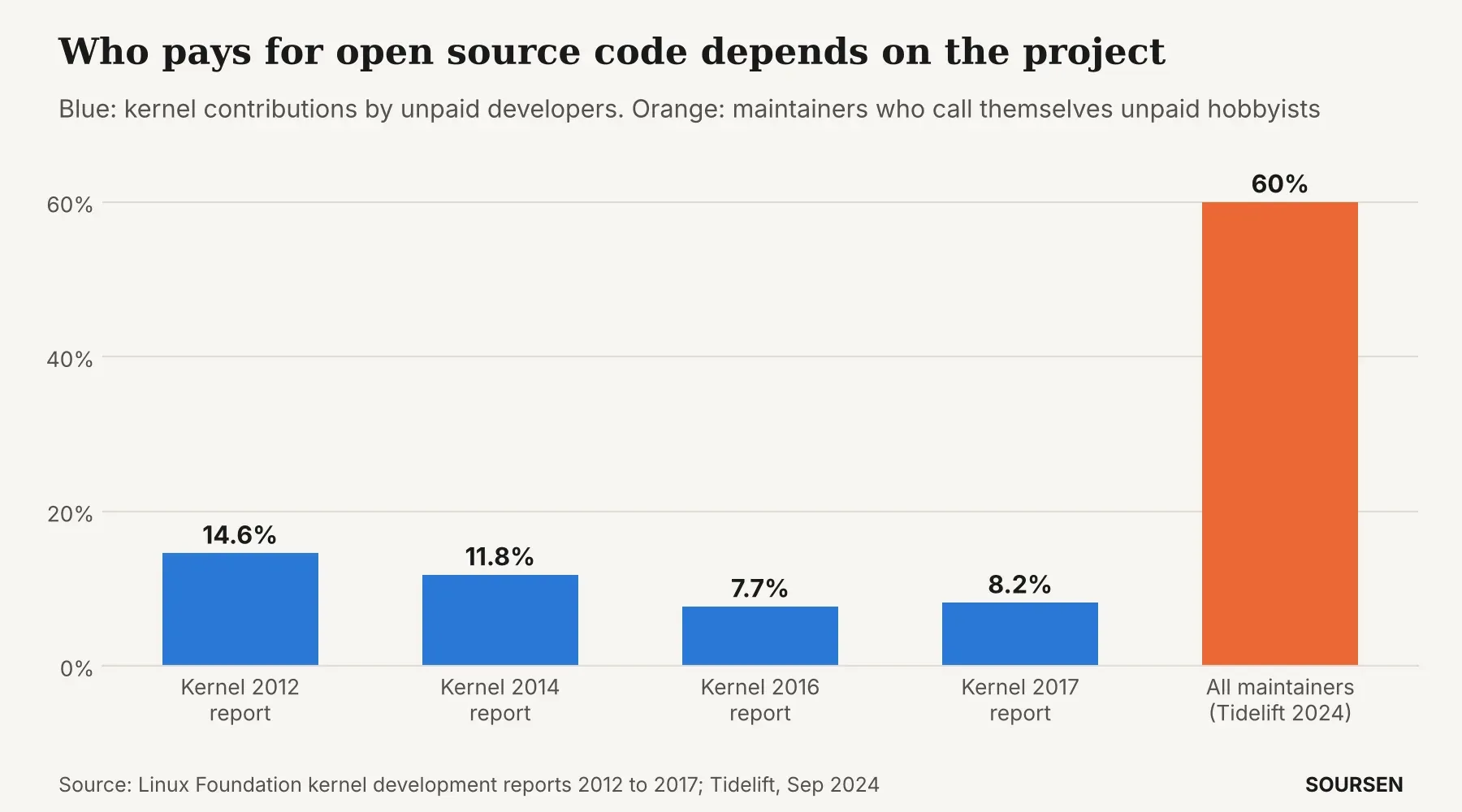
Who pays for open source code depends on the project. Unpaid kernel contributions versus unpaid maintainers overall. Source: Linux Foundation kernel reports 2012 to 2017 and Tidelift, September 2024.
Missing features usually fall into 3 buckets. The feature exists and you missed it. It exists as an extension or plugin. The project decided against it. GNOME’s system tray is the classic third case. GNOME 3.26 stopped showing legacy status icons by default in 2017, and the project’s status icon migration FAQ pointed users to the TopIcons extension. You can disagree with that design call. It was a vision, and the extension existed from day one.
LibreOffice and Microsoft’s formats are a technical problem with a messy history. Office Open XML became an ISO standard in April 2008 after a fast track process. Its specification ran to about 6,000 pages, and the vote drew accusations of irregularities from national bodies including Norway, as The Register and Linux Magazine reported. Brazil, India, South Africa and Venezuela appealed, and ISO rejected the appeals, per Computerworld. Microsoft disputed the criticism and pointed to broad national support. Whatever you think of that fight, matching a 6,000 page spec plus Word’s undocumented behavior is slow work for a small team.
The mirror image of the “lazy devs” take is just as bad. Someone politely asks for a feature and gets told to code it themselves. Asking is fine. Most users cannot code, and they should not need to. A better reply is honest and short. It does not fit our plans, nobody is available, or we will add it to the backlog. Rudeness from users deserves a firm reply. Politeness deserves politeness.
Fragmentation looks scary until you count the distros people actually use
“There are too many distros and desktops, and it is killing Linux.” I hear this one constantly. Yes, there is duplicated effort. KDE developers and GNOME developers will never merge their work, because they hold different design philosophies, and libadwaita reflects choices KDE does not want. That is normal. Car makers do not merge either.
The scale is smaller than the meme suggests. In early 2024, DistroWatch listed 958 distributions, and only 274 were still active, down from 323 active in 2011, according to Linux Magazine’s DistroWatch analysis. Most newcomers choose from maybe 10 to 20 names. The Steam chart above shows the same concentration, with 6 distros accounting for about 62% of Linux gaming systems.
A common version of this take also claims you cannot buy a Linux PC at all. That needs a correction. Dell has sold Ubuntu developer laptops since Project Sputnik in 2012, and Framework ships Fedora on its Laptop 12, according to FOSS Linux. Meanwhile Lenovo sells ThinkPads with Ubuntu or Fedora preinstalled through its Linux laptops page, and System76 and the Steam Machine ship Linux too. It is fair to say Linux PCs are rare on mainstream retail shelves, and It’s FOSS notes almost every non Apple computer sold still comes with Windows. In my view that gap comes down to the apps people expect, such as the full Adobe suite and Microsoft Office, along with the deals PC makers already have with Microsoft.
Asking for money is how free software stays free
Some people treat every donation banner as begware. I think this one has it upside down. Free software has always allowed charging money. The GPL says you may charge any price or no price for each copy, and the FSF says on its selling page that it encourages redistributors to charge as much as they wish or can. You could sell a GPL distro tomorrow, as long as you pass along the source.
Most projects ask gently. elementary OS used to prefill $10 on its download page with an explicit link to download for free. The team published the results in a blog post about payments. About 99.875% of users downloaded without paying, and among the few who paid, the most common amounts were $10 and $1. Today the page reads “Pay What You Can” and you can enter any amount, including $0, on the elementary OS homepage. Founder Daniel Foré said in 2021 that the model let elementary hire several employees and regular contractors, as The Register reported. A tiny share of paying users still adds up to salaries.
LibreOffice shows what donations pay for. The Document Foundation reported €1,976,825 in donations for 2025 and total spending of €1,457,343, of which €1,091,032 went to staff and operations, according to its 2025 financial report. That budget supports an office suite that recorded more than 35 million downloads in a year, per Punto Informatico. When the foundation added a donation banner to the Start Center, some users complained. It is a banner on a free product.
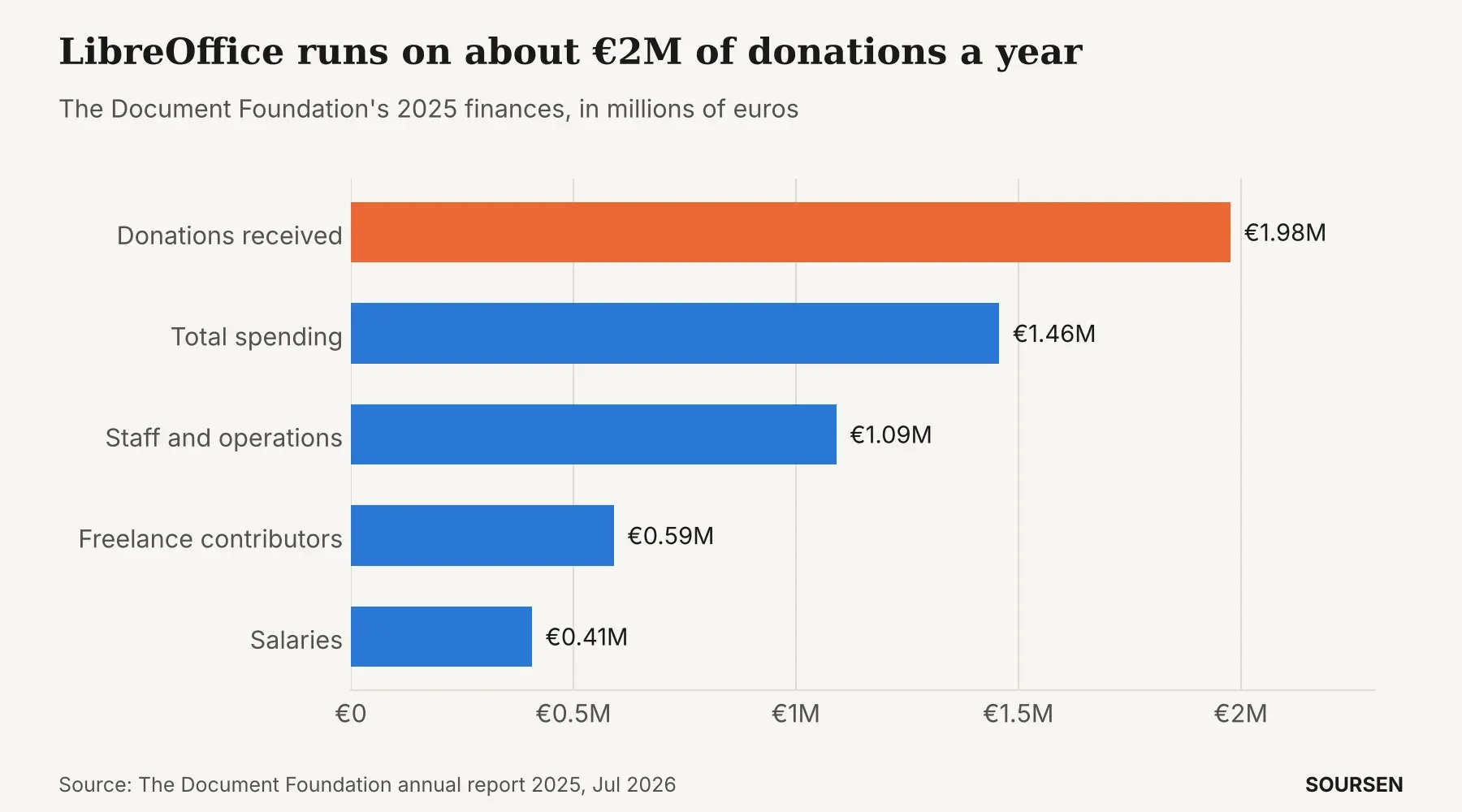
LibreOffice runs on about €2M of donations a year. The Document Foundation’s 2025 finances. Source: The Document Foundation annual report, July 2026.
Open source gets more eyes on its code, and in 2026 many of those eyes are AI models
The last take is the one that annoys me most. “Open source is less secure because anyone can read the code.” Attackers can read it, yes. So can defenders, and this year defenders brought AI.
In February 2026, Anthropic said its Claude Opus 4.6 model found more than 500 previously unknown high severity vulnerabilities in open source libraries, each validated by a person, as Axios reported. In May, an update on Anthropic’s Project Glasswing said Claude Mythos Preview flagged 23,019 potential vulnerabilities across more than 1,000 open source projects, with 6,202 of them estimated as high or critical severity. Of the 1,752 findings reviewed so far by outside security firms or Anthropic’s own researchers, 90.6% held up as valid, and Anthropic said it had disclosed 530 high or critical bugs to maintainers, according to eWeek. These are company reported numbers, and independent tallies are still catching up.
Then on November 4, 2026, OpenAI published research on an automated pipeline pointed at the Linux kernel. Some commentary rounded this to 1,000 CVEs found in a day, which overstates it. According to Phoronix and Cybernews, the run produced 2,308 candidate findings, reproduced 1,724, built 1,169 working exploits and grouped them into 948 distinct local privilege escalation bugs, each with a candidate patch, at an API cost of about $1.2 million. These bugs let someone who already has a low privilege account become root. They do not let a stranger in over the internet. When the 10 day scan and review ended, 61 were already fixed upstream, 43 had patches in staging and 299 were being reported and discussed publicly.
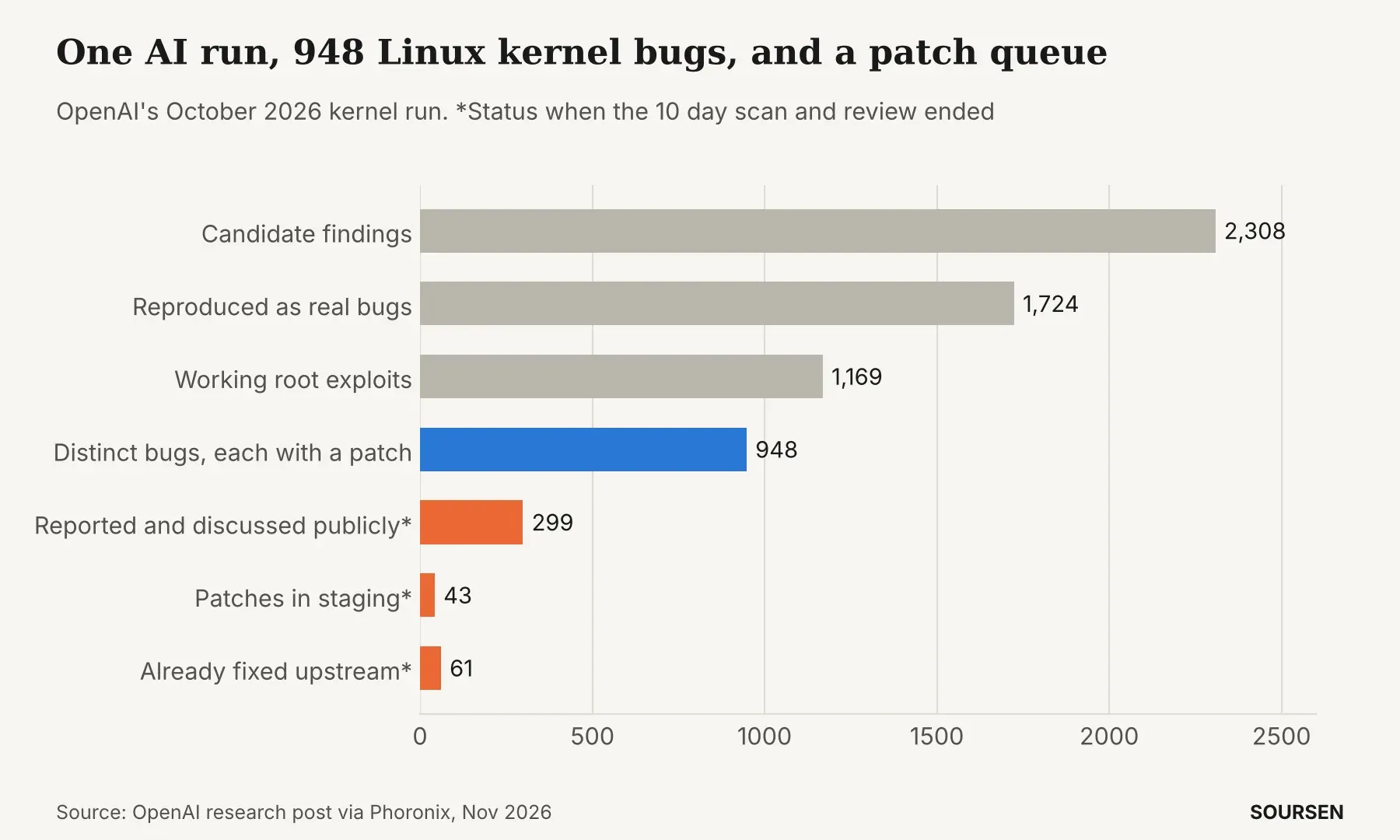
One AI run, 948 Linux kernel bugs, and a patch queue. Stages of OpenAI’s October 2026 kernel run. Source: OpenAI research post via Phoronix, November 2026.
You can read that result as bad news for Linux. I read it as the open model doing its job. Labs can scan the kernel at scale because the source is public, and the fixes flow back to everyone. Microsoft and Apple have to do that work internally on code nobody else can see. Microsoft has also been frank about its own quality problems. Its January 13, 2026 security update for Windows 11 left some PCs unable to boot with an UNMOUNTABLE_BOOT_VOLUME error, after the company had already shipped 2 emergency out of band patches for other bugs in the same release, as Windows Central reported. Around the same time, Microsoft admitted Windows 11 quality fell short of its own standards and moved engineers to fix core pain points, as heise reported. Closed source code is code fewer people can assess, and Microsoft’s own admission shows that keeping it private does not keep it solid.
The fair caveat is the lone maintainer problem. The xz backdoor, found by Microsoft engineer Andres Freund on March 29, 2024, came from an attacker who spent years earning the trust of XZ Utils’ exhausted sole maintainer. Openness helped catch it, because Freund could trace a 500ms SSH slowdown to the source. Underfunding made it possible in the first place. InfoQ compared the case to XKCD 2347, the comic in which modern digital infrastructure balances on one tiny project kept alive by a single volunteer. Open code is safer when people are paid to look after it, and that loops back to the donation banners.
2 things from this generalize
The first is that most bad Linux takes rest on an imagined user. The starter distro take imagines a user who must keep leveling up. The “read the code” take imagines a user who can audit shell scripts. The “lazy devs” take imagines a project with a billion dollar payroll. Swap in the actual user, an actual maintainer and actual budgets, and the take usually dissolves.
The second is that every Linux statistic needs a population next to it. Steam users, human web traffic, bot traffic, kernel contributors and solo maintainers are different groups, and a number that is true for one can mislead badly for another. The 11.87% headline and the 4.45% human share are both genuine measurements. The second sits much closer to how many people use Linux.
This week, pick one open source app you use every day, check whether it is verified on Flathub or signed by its developer, and if it has a donation page, send it the price of a coffee.
Sources
- Valve Steam Hardware and Software Surveystore.steampowered.com. Accessed 20 November 2026.
- GamingOnLinux, Steam Survey October 2026gamingonlinux.com. Accessed 20 November 2026.
- ComputingForGeeks, Linux on Steam October 2026computingforgeeks.com. Accessed 20 November 2026.
- Phoronix, Steam on Linux just under 4% for October 2026phoronix.com. Accessed 20 November 2026.
- Arch Linux AUR security notice, July 2025lists.archlinux.org. Accessed 20 November 2026.
- It's FOSS, CHAOS RAT in the AURitsfoss.com. Accessed 20 November 2026.
- It's FOSS, another RAT in the AURitsfoss.com. Accessed 20 November 2026.
- Daily Security Review, Arch removes malicious AUR packagesdailysecurityreview.com. Accessed 20 November 2026.
- The Register, Arch users told to purge Firefox forkstheregister.com. Accessed 20 November 2026.
- Flathub, verification for usersdocs.flathub.org. Accessed 20 November 2026.
- GamingOnLinux, Flathub flags unverified appsgamingonlinux.com. Accessed 20 November 2026.
- GNU Project, initial announcementgnu.org. Accessed 20 November 2026.
- GNU Project, Selling Free Softwaregnu.org. Accessed 20 November 2026.
- Linus Torvalds, original Linux announcement (archive)lore.kernel.org. Accessed 20 November 2026.
- Ghacks, Steam Machine price and launchghacks.net. Accessed 20 November 2026.
- StatCounter, Android share across platformsgs.statcounter.com. Accessed 20 November 2026.
- Phoronix, Photoshop 2025 installer working with patched Winephoronix.com. Accessed 20 November 2026.
- Phoronix, Wine-Staging 11.1 Photoshop patchesphoronix.com. Accessed 20 November 2026.
- GamingOnLinux, StatCounter shows Linux over 7% globallygamingonlinux.com. Accessed 20 November 2026.
- PCWorld, Linux did not actually hit 10%pcworld.com. Accessed 20 November 2026.
- TechnologyChecker, Linux market share 2026technologychecker.io. Accessed 20 November 2026.
- OMG! Ubuntu, Adobe Creative Cloud Wine patchesomgubuntu.co.uk. Accessed 20 November 2026.
- The Register, curl ends bug bountytheregister.com. Accessed 20 November 2026.
- Bugcrowd, the end of the curl bug bountybugcrowd.com. Accessed 20 November 2026.
- Linux Foundation, 2017 kernel development reportlinuxfoundation.org. Accessed 20 November 2026.
- Tidelift, 2024 State of the Open Source Maintainerbusinesswire.com. Accessed 20 November 2026.
- Socket, the unpaid backbone of open sourcesocket.dev. Accessed 20 November 2026.
- GNOME, status icon migration FAQwiki.gnome.org. Accessed 20 November 2026.
- The Register, OOXML approved as ISO standardtheregister.co.uk. Accessed 20 November 2026.
- Linux Magazine, OOXML is an ISO standardlinux-magazine.com. Accessed 20 November 2026.
- Computerworld, ISO rejects OOXML appealscomputerworld.com. Accessed 20 November 2026.
- Linux Magazine, Digging into DistroWatchlinux-magazine.com. Accessed 20 November 2026.
- Lenovo, Linux laptops and desktopslenovo.com. Accessed 20 November 2026.
- It's FOSS, places to buy Linux computersitsfoss.com. Accessed 20 November 2026.
- elementary blog, paymentsblog.elementary.io. Accessed 20 November 2026.
- elementary OS homepageelementary.io. Accessed 20 November 2026.
- The Document Foundation, 2025 financialsblog.documentfoundation.org. Accessed 20 November 2026.
- It's FOSS, LibreOffice donation banneritsfoss.com. Accessed 20 November 2026.
- Axios, Claude Opus 4.6 finds security flawsaxios.com. Accessed 20 November 2026.
- eWeek, Claude Mythos flags 23K potential flawseweek.com. Accessed 20 November 2026.
- Phoronix, OpenAI finds 948 kernel LPE bugsphoronix.com. Accessed 20 November 2026.
- Cybernews, OpenAI agent uncovers Linux kernel flawscybernews.com. Accessed 20 November 2026.
- Punto Informatico, LibreOffice download recordpunto-informatico.it. Accessed 20 November 2026.
- heise, Microsoft promises Windows 11 improvementsheise.de. Accessed 20 November 2026.
- CSO Online, xz Utils backdoorcsoonline.com. Accessed 20 November 2026.
- KitGuru, Steam survey October 2025 distroskitguru.net. Accessed 20 November 2026.
- Korben, malicious packages in the AURkorben.info. Accessed 20 November 2026.
- Flathub, app safety layered approachdocs.flathub.org. Accessed 20 November 2026.
- openSUSE News, End of 10 campaignnews.opensuse.org. Accessed 20 November 2026.
- KDE Akademy 2025, End of 10 talkconf.kde.org. Accessed 20 November 2026.
- Daniel Stenberg, bug bounty postsdaniel.haxx.se. Accessed 20 November 2026.
- The Stack, curl leaves HackerOnethestack.technology. Accessed 20 November 2026.
- Michael Tsai, curl removes bug bountiesmjtsai.com. Accessed 20 November 2026.
- Phoronix, kernel staging rejects LLM patchesphoronix.com. Accessed 20 November 2026.
- Linux Magazine, staging area rejects AI patcheslinux-magazine.com. Accessed 20 November 2026.
- Linux Foundation, 2015 kernel development reportlinuxfoundation.org. Accessed 20 November 2026.
- The New Stack, who contributes to the Linux kernelthenewstack.io. Accessed 20 November 2026.
- EU OSOR, Sovereign Tech Fund case studyinteroperable-europe.ec.europa.eu. Accessed 20 November 2026.
- Help Net Security, Sovereign Tech Fund invests in KDEhelpnetsecurity.com. Accessed 20 November 2026.
- FOSS Linux, buying a Linux friendly laptopfosslinux.com. Accessed 20 November 2026.
- The Register, elementary OS 6 Odintheregister.com. Accessed 20 November 2026.
- Windows Central, January 2026 Windows 11 boot failureswindowscentral.com. Accessed 20 November 2026.
- InfoQ, xz backdoorinfoq.com. Accessed 20 November 2026.
- Cybernews, Linux use surges in North Americacybernews.com. Accessed 20 November 2026.
Related stories
More in Linux
Security
The Arch AUR Keeps Getting Hit With Malware, and the Fixes All Cost Something
On 13 October 2026 an account mass uploaded a pile of packages to the Arch User Repository that looked like the popular helper yay and ran code the attacker controlled as root the moment you installed them. It was the fourth malware wave on the AUR in about 15 months. I went through what actually happened, how the trick worked at the file level, and why the obvious fix is the one thing that would stop the AUR from being the AUR.
Linux & open source
Almost Half of 8th Graders Can't Handle Basic Computer Tasks. The Year of the Linux Desktop Has a Bigger Problem Than Drivers.
Linux keeps getting easier to install. Meanwhile a generation raised on phones, tablets and Chromebooks is losing the computer skills Linux quietly assumes. I checked what the data says about computer literacy in 2026.
Linux & open source
Apple Never Documented the M1. A Handful of Volunteers Taught Linux to Run on It Anyway, Then Most of Them Left
Asahi Linux reverse engineered Apple Silicon from scratch and shipped the first conformant graphics drivers for Apple's GPU on any operating system. In 2025 its founder quit after a fight over Rust in the Linux kernel, and 2 of its graphics developers stepped away within months. I walk through how they did it, why it fell apart and where Linux on the Mac stands in November 2026.