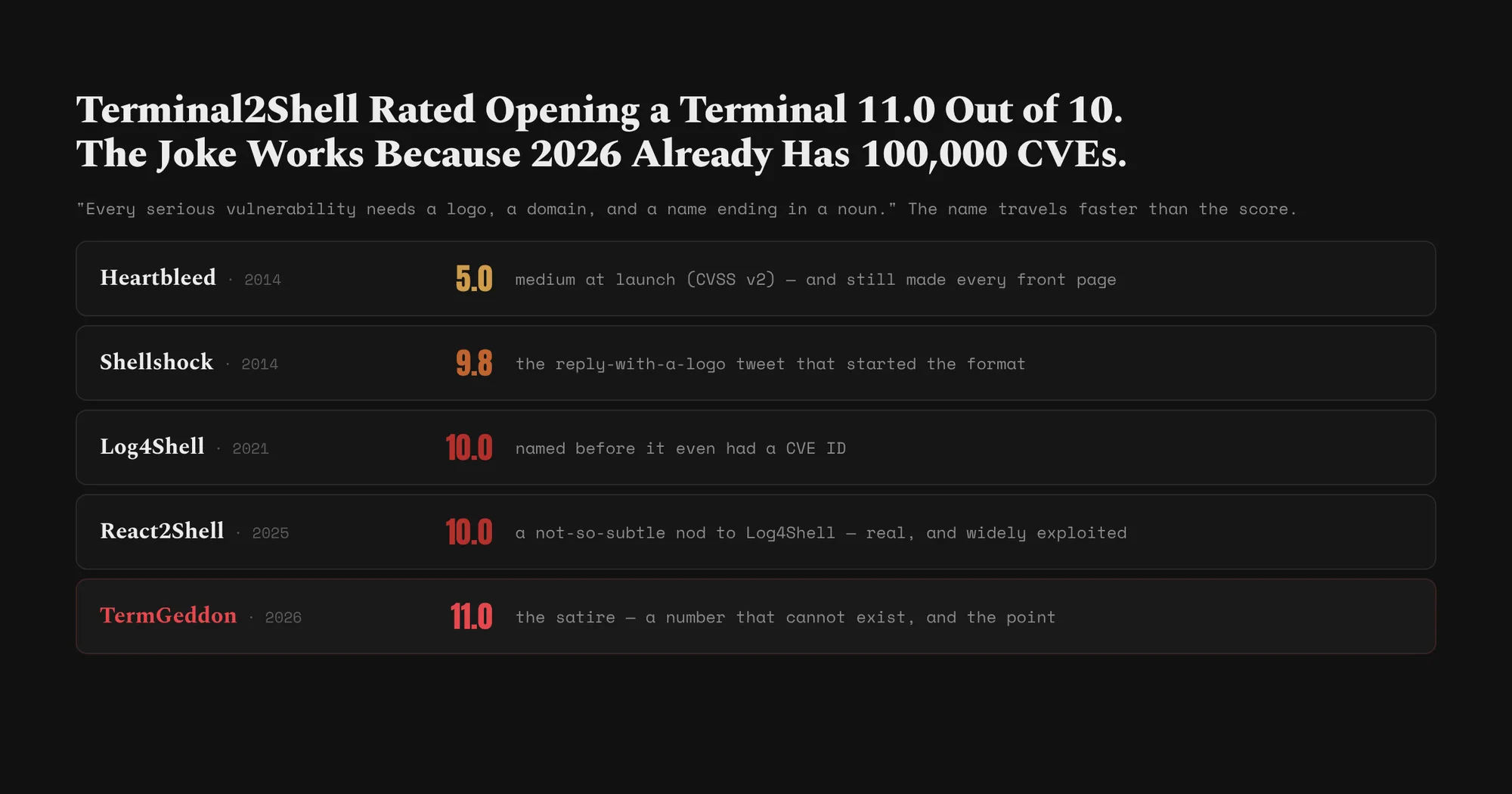
Terminal2Shell Rated Opening a Terminal 11.0 Out of 10. The Joke Works Because 2026 Already Has 100,000 CVEs.
A satire site dressed up the most normal thing a computer does as a world ending vulnerability, complete with a logo, a domain and a severity score off the scale. Here is the history it is mocking, the numbers behind it, and how to read the next scary bug page without panicking.
Last verified
On this page
- A satire page scored opening a terminal at 11.0
- Every claim on the page is technically accurate
- Heartbleed started the habit of naming bugs in 2014
- The Shell suffix has its own family tree
- 11.0 does not exist on the CVSS scale
- 2026 passed 100,000 CVEs in November
- Only a sliver of those bugs ever gets used
- The people checking the bugs fell behind
- AI made the noise louder for small projects
- Terminal bugs exist, and they look nothing like the joke
- How to read the next scary vulnerability page
- 2 things from this generalize
In November a web page called Terminal2Shell started doing the rounds after it was featured on GeekNews, a Korean tech news aggregator. It announced a flaw present in every operating system since 1971. Anyone who opens a terminal gets a fully interactive shell. The page rated it 11.0, topped it with a banner claiming active exploitation and more than 2 billion affected devices, and listed the vendor response as “That is what a terminal is.”
It is a joke, and a good one. I want to walk through why it lands so well in 2026, because every piece of it parodies something the security industry already does. Vulnerabilities get brand names and logos. Severity scores get inflated. The number of CVEs published this year has passed 100,000, and the people who are supposed to check them have fallen badly behind. I will also cover what a genuine terminal bug looks like, and a short checklist for reading the next alarming vulnerability page.
A satire page scored opening a terminal at 11.0
According to a breakdown by braindetox, which captured the page on November 10, Terminal2Shell is formatted exactly like a serious disclosure. The exploitation section has a single step, open a terminal, with a struck through line underneath noting there is no second step. The time to exploit is listed as 0 ms and the complexity as 1 click. The CVE ID is pending, and the bug has an alternate name, TermGeddon. The page carries no label saying it is satire. You work that out from the content.
The affected list marks macOS, Linux, Windows and more as vulnerable. Microsoft Paint is marked as not affected. The mitigations are the best part. Closing the terminal is a partial fix, since reopening it brings the vulnerability back. Setting your shell to /bin/false fully fixes the problem, and also fully removes your ability to use the computer. The FAQ explains that every serious vulnerability needs a logo, a domain and a name ending in a number followed by a noun, and this one has all 3.
The disclosure timeline starts in 1971 and treats each new Unix shell as another chapter in a cover up. It ends with researchers notifying vendors, registering a domain, designing a logo and contacting the press. The page also claims telemetry shows millions of developers exploiting the bug every day, and describes its proof of concept as fully weaponized.
Every claim on the page is technically accurate
The joke works because nothing in it is false. A terminal emulator is a program that draws text and passes your keystrokes to another program, usually a shell. The shell runs whatever you type with your own permissions. That is the design, and it has been since Ken Thompson wrote the first Unix shell for the first edition of Unix, released on November 3, 1971. That makes the page’s claim of 55 years of exposure correct to the month.
The rest of the history checks out too. Stephen Bourne’s shell replaced Thompson’s in Version 7 Unix in 1979, and the GNU project’s Bourne Again Shell followed in 1989, according to Opensource.com’s history of the shell. Getting from your own account to root through sudo still needs your password. In the usual “attack,” the attacker and the user are the same person.
What the page mocks is the packaging. Take an ordinary fact, attach a dramatic name, a score, an alarming banner and an FAQ, and it starts to look like news. The security industry has been doing that since 2014.
Heartbleed started the habit of naming bugs in 2014
The branded vulnerability has a birthday. In April 2014 OpenSSL disclosed CVE-2014-0160, a missing bounds check in its TLS heartbeat code that let anyone read chunks of a server’s memory. Google researcher Neel Mehta and the Finnish firm Codenomicon found it independently. Codenomicon gave it a name, Heartbleed, coined by one of its engineers, Ossi Herrala, and launched heartbleed.com with an FAQ and a bleeding heart logo by designer Leena Snidate, as Dark Reading and Fast Company reported at the time.
It worked. The bug reached front pages and got patched quickly. It also drew criticism. One critic quoted by eWEEK the launch felt like a marketing and PR play, and predicted others would copy it. A Codenomicon representative told the same outlet the intent was to inform, and that the domain happened to be available. CISA eventually added Heartbleed to its Known Exploited Vulnerabilities catalog in May 2022, 8 years after disclosure, according to CIRCL’s CVE record.
Here is the detail I find funniest in hindsight. The most famous branded bug of all time scored only 5.0 under the CVSS version 2 system in use in 2014, a medium rating, according to Aqua’s copy of the NVD record. It is rated 7.5, high, under the newer CVSS 3.1. The number and the name told 2 very different stories about the same bug, and the name won.
The trend spread within months. When a remote code execution bug turned up in Bash in September 2014, researcher Davi Ottenheimer joked on Twitter that it was not big until there was a logo, and Andreas Lindh replied with one and the name Shellshock, Axios recounted. CVE-2014-6271 carries a 9.8 under CVSS 3.1, per Ubuntu’s security tracker. Cloudflare said it was tracking about 1.5 million Shellshock attacks and probes a day shortly after disclosure, according to Wikipedia’s account.
By 2018 the format was standard. Meltdown and Spectre, the processor flaws disclosed on January 3 that year, launched with a shared website, free logos by designer Natascha Eibl released under CC0, and an FAQ. Asked whether you were affected, meltdownattack.com answered “Most certainly, yes.” That answer was accurate, since the Spectre class touched nearly every modern processor, and it reads almost exactly like a line from Terminal2Shell.
The names also got cleverer. In July 2024 Qualys disclosed CVE-2024-6387 in OpenSSH’s server and called it regreSSHion, because it was a regression of a bug fixed back in 2006 that slipped back in with OpenSSH 8.5p1 in October 2020, per Qualys. Qualys found more than 14 million internet exposed OpenSSH servers that were potentially vulnerable, TechTarget reported. Within days, SecurityWeek reported that exploitation was hard enough to make mass attacks unlikely, and confirmed attacks in the wild had yet to appear. A serious bug with a great name, and a much smaller blast radius in practice than the headlines implied.
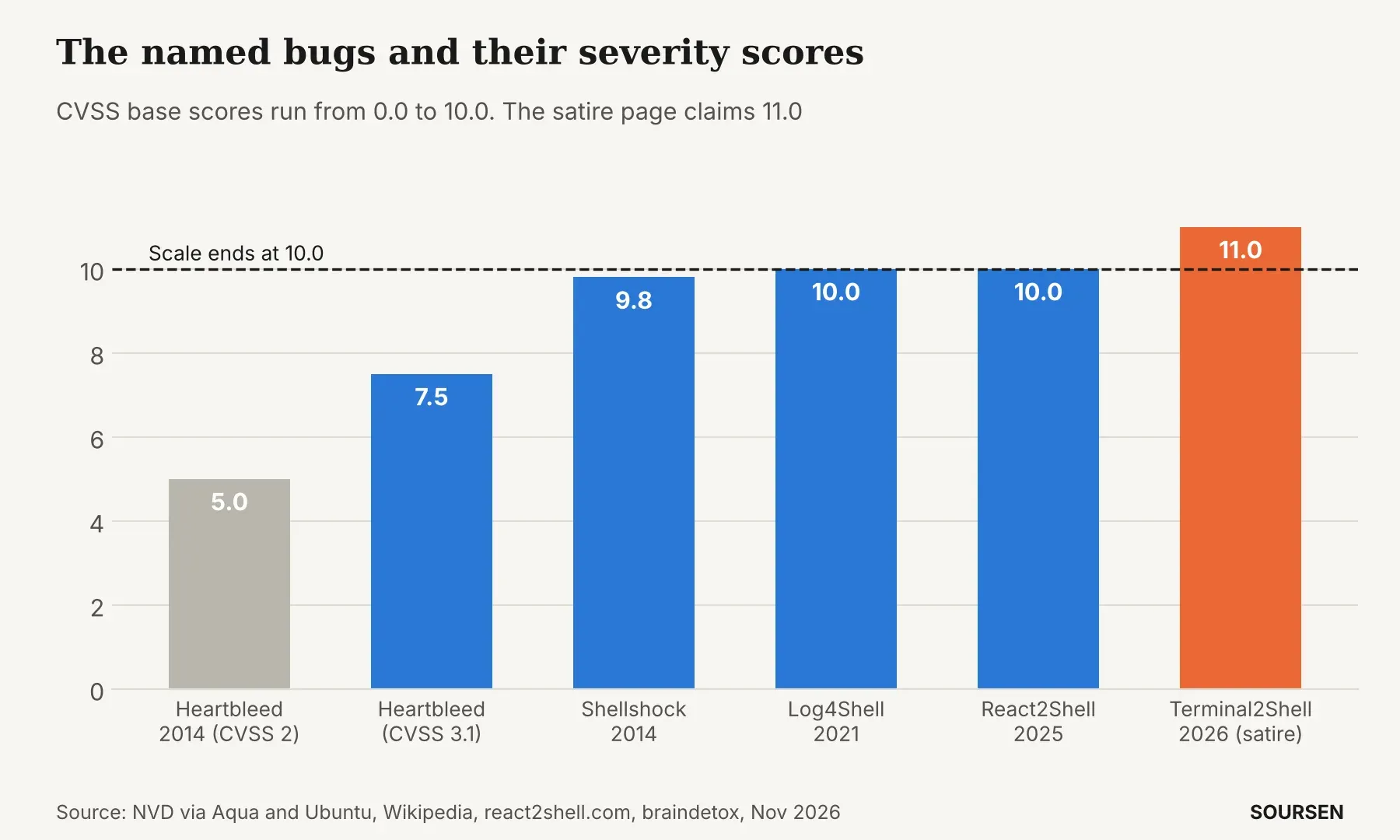
The named bugs and their severity scores. CVSS base scores run from 0.0 to 10.0, and the satire page claims 11.0. Source: NVD via Aqua and Ubuntu, Wikipedia and react2shell.com, November 2026.
The Shell suffix has its own family tree
Terminal2Shell is a dig at a specific naming pattern. In December 2021 a flaw in the Java logging library Log4j, CVE-2021-44228, circulated under the name Log4Shell before it even had an official CVE ID. The name came from Free Wortley of the LunaSec team, according to Wikipedia’s Log4Shell entry. It scored the maximum 10.0, Malwarebytes reported that exploitation had been seen as early as December 1, and CISA gave US federal agencies until Christmas Eve to patch. IBM’s X-Force attributed most of a 34% rise in vulnerability exploitation between 2020 and 2021 to Log4Shell, according to IBM.
Then came React2Shell. On December 3, 2025, the React team disclosed CVE-2025-55182, an unsafe deserialization flaw in React Server Components that allowed unauthenticated remote code execution. It got a 10.0, a name that Infosecurity Magazine called a not so subtle nod to Log4Shell, and its own site at react2shell.com. CISA added it to its Known Exploited Vulnerabilities catalog on December 5, Rapid7 noted. Next.js filed a separate CVE that NVD later rejected as a duplicate.
Both of those were serious, widely exploited bugs, and the catchy names helped admins find them fast. The satire still lands, because the suffix has become shorthand for “this one is bad,” and a name that ends in Shell now carries alarm before anyone reads the details. There is also a quiet joke underneath. Nearly every demonstration of a remote code execution bug ends the same way, with the researcher typing commands into a shell. Terminal2Shell simply skips the part where anything goes wrong.
11.0 does not exist on the CVSS scale
The Common Vulnerability Scoring System, maintained by FIRST, produces base scores from 0.0 to 10.0. Version 4.0 labels them None at 0.0, Low from 0.1 to 3.9, Medium from 4.0 to 6.9, High from 7.0 to 8.9 and Critical from 9.0 to 10.0. As braindetox points out, a base score describes the bug’s intrinsic characteristics under a reasonable worst case. Whether anyone is exploiting it belongs in separate threat metrics, and NVD usually publishes only the base score. An 11.0 with no version and no vector string is the tell that you are reading satire.
The joke about inflation has a point, though. Researcher Jerry Gamblin counted 36 CVEs scored a perfect 10 in 2023 alone, with an average score of 7.12, SecurityWeek reported. A study covered by The Register cited research finding more than 40% of CVEs get a different score when the same person rescores them 9 months later.
Daniel Stenberg, who leads the curl project, has the best horror story. In August 2023 an anonymous person filed CVE-2020-19909 against curl, describing an integer overflow that the curl team says was a harmless bug fixed years earlier. NVD rated it 9.8 critical. Stenberg asked MITRE to reject it and was refused, and the record was eventually flagged as disputed, per curl’s own page on the bogus CVE. Feedly lists it at 3.3 today. In January 2025 Stenberg published CVSS is dead to us, explaining that curl rates its own issues and ignores the system.
Sonatype’s look at open source vulnerabilities disclosed in 2025 found a broader pattern. Of 1,552 vulnerabilities, 64% had no NVD severity score at all. Among the ones that were scored, NVD overstated severity in 62% of cases, and fewer than 1 in 5 ratings matched Sonatype’s assessment, according to ITPro. Sonatype sells software supply chain tools, so it has a commercial interest in the CVE system looking unreliable. Defenders of CVSS, quoted by CyberScoop, argue the system is imperfect but still the best shared language for severity, and that misuse by organizations causes most of the trouble.
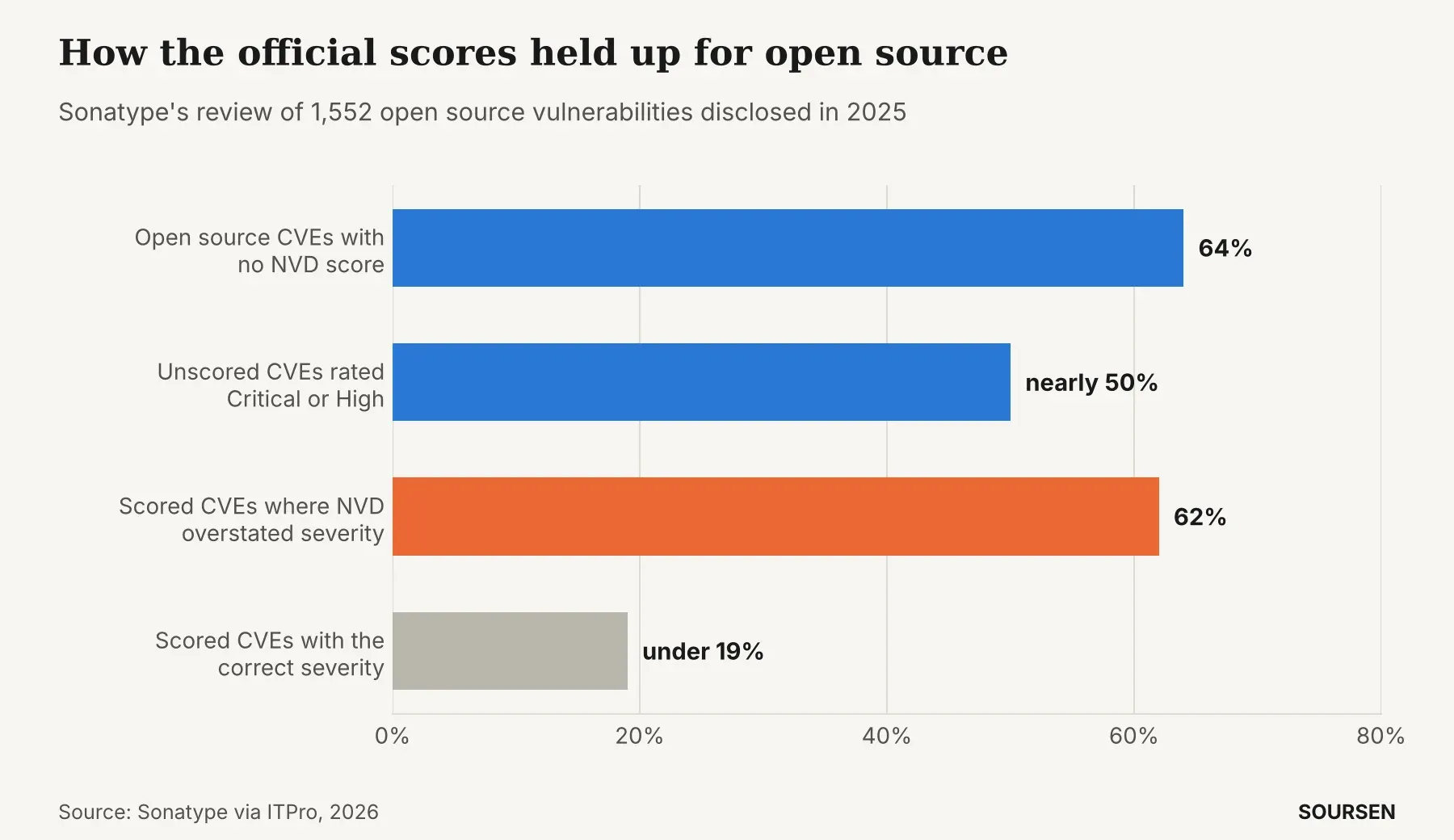
How the official scores held up for open source. Sonatype’s review of 1,552 open source vulnerabilities disclosed in 2025. Source: Sonatype via ITPro, 2026.
2026 passed 100,000 CVEs in November
Terminal2Shell’s banner claims 2 billion affected devices. The number that should make you blink is the CVE count. On November 13, VulnCheck counted 100,222 CVEs published so far in 2026, more than double the whole of 2025, The Register reported. VulnCheck’s Josh Bressers put the cause bluntly, saying AI powered vulnerability hunting drives most of what they are seeing. His summary was “We don’t have a security problem anymore. We have a data problem now.”
The growth had already been steep. Annual counts sat between roughly 4,000 and 8,000 from 2005 to 2016, according to K2 Cyber Security’s analysis, then jumped to more than 14,600 in 2017 as more organizations got the right to issue CVE IDs, Rapid7 noted. The same post marked a milestone. MITRE published the 100,000th CVE identifier on April 24, 2018, nearly 2 decades after the program started with 894 entries in its first year. In 2026 the world published that many in about 10 and a half months. FIRST counted 40,704 in 2024, and 2025 closed at a record 48,185, according to The Stack. The 2026 total is already about 15 times the 2016 figure.
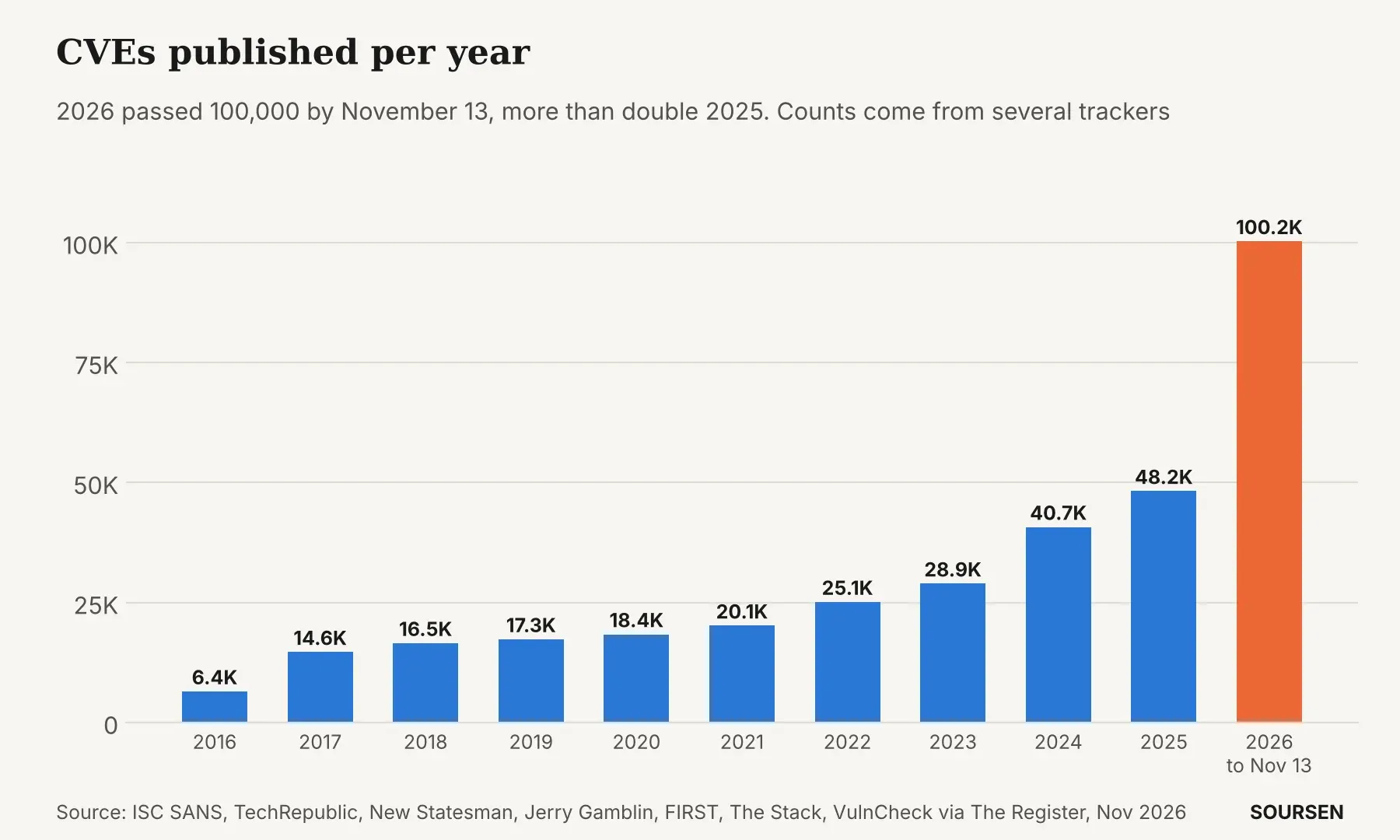
CVEs published per year. 2026 passed 100,000 by November 13, more than double 2025. Source: ISC SANS, TechRepublic, New Statesman, Jerry Gamblin, FIRST, The Stack and VulnCheck via The Register, November 2026.
Where the numbers come from matters. Mondoo’s state of vulnerabilities report found that 2 WordPress security firms, Patchstack and Wordfence, assigned 10,474 CVEs in 2025, about 21.7% of the total and more than 5 times the 1,976 from Microsoft, Google and Apple combined. The same report counted 5,803 Linux kernel CVEs, 85% of them with no CVSS score, because the kernel team decided not to score its own bugs after becoming a CVE Numbering Authority in 2024.
Severity is moving the other way. Trend Micro, citing an analysis by Zafran of NVD data, reports that the share of critical vulnerabilities roughly halved from about 13% in 2024 to 7% in 2025. More bugs, proportionally fewer catastrophic ones.
Only a sliver of those bugs ever gets used
Terminal2Shell says it is exploited millions of times a day, which is true if you count every developer who opens a terminal. For actual CVEs, the exploited share is tiny. Of the 100,222 published in 2026 by mid November, about 1.4%, or 1,363, had made it into VulnCheck’s known exploited catalog. The FIRST Exploit Prediction Scoring System estimates that only around 5% of all published CVEs are ever seen being exploited, per Trend Micro.
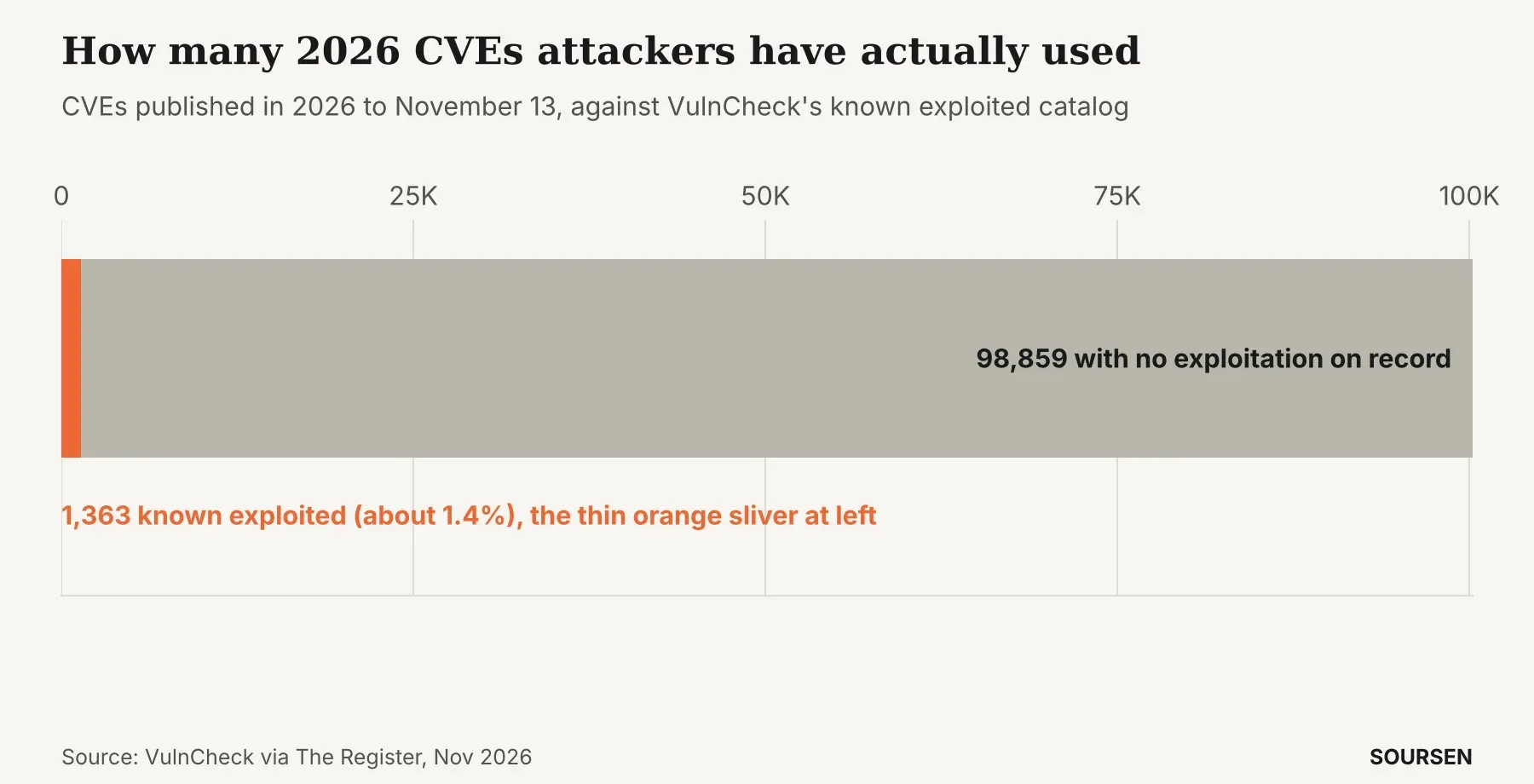
How many 2026 CVEs attackers have actually used. CVEs published in 2026 to November 13, against VulnCheck’s known exploited catalog. Source: VulnCheck via The Register, November 2026.
CISA keeps its own, stricter list. A vulnerability only gets onto the Known Exploited Vulnerabilities catalog with a CVE ID, reliable evidence of malicious use and a clear fix. Research scanning and proof of concept code do not count on their own. CISA added 245 entries in 2025, bringing the total to 1,484, according to Zafran. The November 9, 2026 release had 1,773 entries, and braindetox checked that neither Terminal2Shell nor TermGeddon appears.
The small share does not make the dangerous ones slow. VulnCheck told The Register the median time from CVE publication to exploitation fell from 120 days in 2025 to 80 days in the first half of 2026. The hard part for defenders is finding the 1.4% inside the other 98.6%.
The people checking the bugs fell behind
That sorting job used to lean heavily on the National Vulnerability Database, run by NIST, which added scores, product lists and weakness types to each CVE. A backlog of unprocessed entries began in February 2024 and kept growing. A May 26, 2026 report from the Commerce Department’s Office of Inspector General found more than 27,000 unprocessed vulnerabilities and criticized NIST’s lack of strategic planning, according to NowSecure’s summary and the OIG report itself. The OIG projected more than 60,000 CVEs for 2026. The actual count is already past 100,000.
The CVE program itself nearly went dark a year earlier. MITRE has run it under a US government contract since 1999. On April 15, 2025 MITRE warned the CVE board that its funding would expire the next day, and CISA exercised an 11 month option on the $57.8 million contract only hours before the deadline, extending it to March 16, 2026, The Record reported. Members of the CVE board launched a nonprofit CVE Foundation the same week to push for funding that does not depend on a single government sponsor, according to The Register.
NIST had already changed course. On April 15, 2026 it stopped trying to enrich every CVE, citing a 263% rise in submissions between 2020 and 2025. It now prioritizes a narrower set, including CVEs on CISA’s exploited list and software covered by Executive Order 14028, which the Cloud Security Alliance estimates at 15% to 20% of annual volume. About 29,000 backlogged CVEs published before March 1 were moved to a “Not Scheduled” status. NIST also said it would rely on the severity score supplied by whoever issued the CVE, Help Net Security reported.
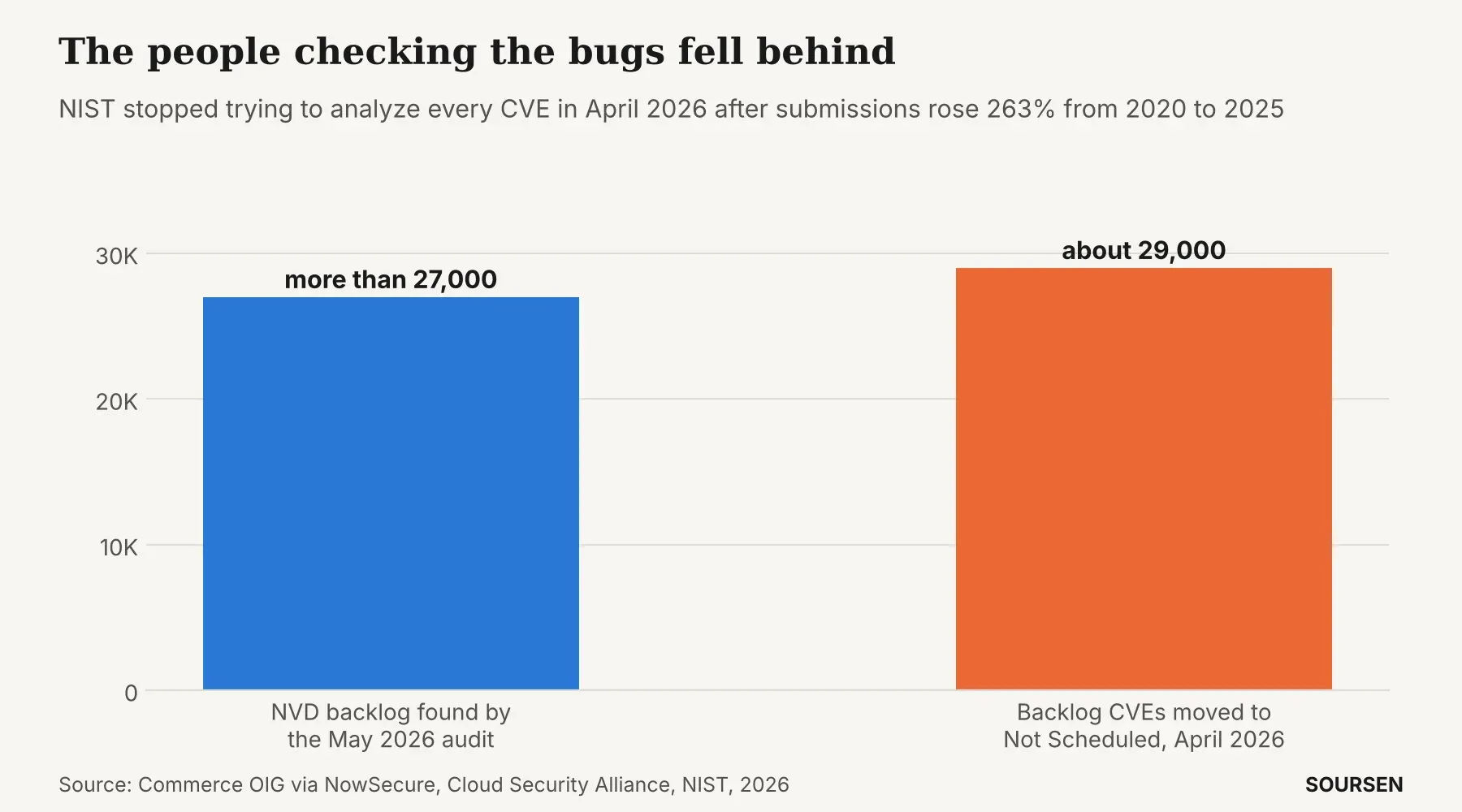
The people checking the bugs fell behind. NIST stopped trying to analyze every CVE in April 2026. Source: Commerce OIG via NowSecure, Cloud Security Alliance and NIST, 2026.
AI made the noise louder for small projects
The flood hits volunteer maintainers hardest. Stenberg ended curl’s bug bounty on January 31, 2026, saying he wanted to remove the incentive for people to submit poorly researched reports, AI generated or not, according to The Register. Over about 6 years the program paid $86,000 for 78 confirmed vulnerabilities, and by mid 2025 roughly 20% of submissions were what Stenberg calls AI slop, per Bugcrowd. Neowin put total payouts above $100,000, so the reports disagree on that figure. In the week before the announcement, the program received 7 submissions and none described a security vulnerability, SC World reported.
Stenberg has been careful to separate the tool from the abuse. Michael Tsai’s roundup notes that Stenberg knows of more than 100 good AI assisted reports that led to fixes in curl. The same roundup quotes a later Stenberg note that, as part of Anthropic’s Project Glasswing, Anthropic offered open source projects access to its latest AI model through the Linux Foundation. The tools that flood maintainers with junk are also the ones finding a growing share of genuine bugs. The problem he describes is volume without judgment. A confident report about a scary sounding flaw takes seconds to generate and hours to disprove, which is the exact dynamic Terminal2Shell exaggerates for laughs.
Terminal bugs exist, and they look nothing like the joke
Terminals do have security bugs. They tend to come from the terminal trusting text it should treat as display only. Terminals understand escape sequences, special characters that change colors, set window titles or talk to helper features. A write up on terminal emulator security traces this class of bug back to an xterm flaw, CVE-2008-2383, found by Paul Szabo in 2008.
A recent example came from Calif in April 2026. Its researchers showed that iTerm2’s SSH integration, which talks to a small helper script over special terminal sequences, did not check that those sequences came from the genuine helper. A plain text file could contain fake replies, and simply displaying it with cat could lead iTerm2 to run code the file’s author chose. The fix landed in iTerm2’s code on March 31, though it had not reached a stable release when Calif published its write up. That is a design mistake in a specific feature with a specific fix, which is what a vulnerability report should describe.
How to read the next scary vulnerability page
The braindetox breakdown doubles as a checklist, and I would use it on any alarming page. First, look for a CVE ID and confirm it exists in the CVE list or NVD. “Pending” with a logo already designed is a yellow flag. Second, check the score has a CVSS version and a vector string, and that it sits between 0.0 and 10.0. Third, look for a vendor advisory with affected versions and a patched version. A page that names products but no versions is telling you less than it seems.
Fourth, check CISA’s Known Exploited Vulnerabilities catalog and the EPSS score from FIRST before deciding how fast to move. A 9.8 with no exploitation and a low EPSS can usually wait for the normal patch cycle. A 7.5 on the KEV list in software you expose to the internet cannot. Finally, ask whether the bug applies to the way you use the software. Stenberg’s complaint about CVSS is exactly that a generic score cannot know your setup.
2 things from this generalize
The first is that a name, a logo and a big number measure attention. Heartbleed scored a medium 5.0 when it launched and still deserved every headline, while curl’s 9.8 was a non issue. The useful signals are boring ones, a patched version, an exploitation record and whether the vulnerable feature is turned on in your systems.
The second is that volume has become the problem. With more than 100,000 CVEs this year and NIST enriching only a fraction, every team now has to do its own triage, and the ones that sort by exploitation evidence will spend their time on the bugs attackers use.
This week, pick the last vulnerability alert that made your team scramble and check it against the KEV catalog and its EPSS score. If it was not on the list and scored low, write down what that scramble cost, and use it to argue for triaging by exploitation first next time.
Sources
- braindetox, Terminal2Shell is a satire pagebraindetox.kr. Accessed 23 November 2026.
- The Register, This year's bug count just passed 100Ktheregister.com. Accessed 23 November 2026.
- Wikipedia, Thompson shellen.wikipedia.org. Accessed 23 November 2026.
- Wikipedia, Bourne shellen.wikipedia.org. Accessed 23 November 2026.
- Opensource.com, The birth of the Bash shellopensource.com. Accessed 23 November 2026.
- Dark Reading, Heartbleed and naming vulnerabilitiesdarkreading.com. Accessed 23 November 2026.
- Fast Company, Why Heartbleed has a catchy logofastcompany.com. Accessed 23 November 2026.
- eWEEK, Heartbleed disclosure angsteweek.com. Accessed 23 November 2026.
- Aqua Security, CVE-2014-0160 NVD recordavd.aquasec.com. Accessed 23 November 2026.
- Axios, How Heartbleed turned vulnerabilities into brandsaxios.com. Accessed 23 November 2026.
- Ubuntu, CVE-2014-6271ubuntu.com. Accessed 23 November 2026.
- Wikipedia, Shellshockwikipedia.org. Accessed 23 November 2026.
- Wikipedia, Log4Shellen.wikipedia.org. Accessed 23 November 2026.
- Malwarebytes, Log4Shell arrivesmalwarebytes.com. Accessed 23 November 2026.
- IBM, What is the Log4j vulnerabilityibm.com. Accessed 23 November 2026.
- Infosecurity Magazine, Total published CVEs hit record highinfosecurity-magazine.com. Accessed 23 November 2026.
- Infosecurity Magazine, React.js hit by React2Shellinfosecurity-magazine.com. Accessed 23 November 2026.
- react2shell.comreact2shell.com. Accessed 23 November 2026.
- Rapid7, React2Shell CVE-2025-55182rapid7.com. Accessed 23 November 2026.
- SecurityWeek, Vulnerability handling in 2023securityweek.com. Accessed 23 November 2026.
- The Register, Vulnerability scores, what are they good fortheregister.com. Accessed 23 November 2026.
- curl, CVE-2020-19909 bogus reportcurl.se. Accessed 23 November 2026.
- Daniel Stenberg, CVSS is dead to usdaniel.haxx.se. Accessed 23 November 2026.
- ITPro, Security experts say the CVE program is not up to scratchitpro.com. Accessed 23 November 2026.
- CyberScoop, Infosec pros defend CVSScyberscoop.com. Accessed 23 November 2026.
- The Stack, CVEs in 2025 analysisthestack.technology. Accessed 23 November 2026.
- Mondoo, State of vulnerabilities 2026mondoo.com. Accessed 23 November 2026.
- Trend Micro, Making sense of the vulnpocalypsetrendmicro.com. Accessed 23 November 2026.
- Zafran, The 2025 spike in vulnerabilitieszafran.io. Accessed 23 November 2026.
- NowSecure, The NVD backlog is a symptomnowsecure.com. Accessed 23 November 2026.
- Commerce OIG, NVD evaluation report OIG-26-020-Ioig.doc.gov. Accessed 23 November 2026.
- NIST, NVD operations updatenist.gov. Accessed 23 November 2026.
- Cloud Security Alliance, NVD triage overhaullabs.cloudsecurityalliance.org. Accessed 23 November 2026.
- Help Net Security, NIST will enrich only highest risk CVEshelpnetsecurity.com. Accessed 23 November 2026.
- The Register, Curl shutters bug bountytheregister.com. Accessed 23 November 2026.
- Bugcrowd, curl ends its bug bountybugcrowd.com. Accessed 23 November 2026.
- SC World, cURL ends bug bounty programscworld.com. Accessed 23 November 2026.
- Michael Tsai, curl removes bug bountiesmjtsai.com. Accessed 23 November 2026.
- dgl.cx, Terminal emulator securitydgl.cx. Accessed 23 November 2026.
- Calif, Even cat readme.txt is not safeblog.calif.io. Accessed 23 November 2026.
- CISA, Known Exploited Vulnerabilities catalogcisa.gov. Accessed 23 November 2026.
- CIRCL, CVE-2014-0160 recordcve.circl.lu. Accessed 23 November 2026.
- Rapid7, CVE 100K, a big round numberblog.rapid7.com. Accessed 23 November 2026.
- Meltdown and Spectre official sitemeltdownattack.com. Accessed 23 November 2026.
- Qualys, The regreSSHion bugqualys.com. Accessed 23 November 2026.
- TechTarget, Critical OpenSSH vulnerability could affect millions of serverstechtarget.com. Accessed 23 November 2026.
- SecurityWeek, regreSSHion mass attacks unlikelysecurityweek.com. Accessed 23 November 2026.
- The Record, CISA extends CVE program contract with MITREtherecord.media. Accessed 23 November 2026.
- The Register, CVE program gets last minute fundingtheregister.com. Accessed 23 November 2026.
Related stories
More in Linux
Linux & open source
Almost Half of 8th Graders Can't Handle Basic Computer Tasks. The Year of the Linux Desktop Has a Bigger Problem Than Drivers.
Linux keeps getting easier to install. Meanwhile a generation raised on phones, tablets and Chromebooks is losing the computer skills Linux quietly assumes. I checked what the data says about computer literacy in 2026.

Linux & open source
Just Read the Code, Bro. 9 Linux Takes That Fall Apart When You Check the Numbers
Starter distros, lazy developers, fragmentation, donation guilt and the old claim that open source is less secure. I checked each one against 2026 data, and most of them do not survive.
Linux & open source
Apple Never Documented the M1. A Handful of Volunteers Taught Linux to Run on It Anyway, Then Most of Them Left
Asahi Linux reverse engineered Apple Silicon from scratch and shipped the first conformant graphics drivers for Apple's GPU on any operating system. In 2025 its founder quit after a fight over Rust in the Linux kernel, and 2 of its graphics developers stepped away within months. I walk through how they did it, why it fell apart and where Linux on the Mac stands in November 2026.