Almost Half of 8th Graders Can't Handle Basic Computer Tasks. The Year of the Linux Desktop Has a Bigger Problem Than Drivers.
Linux keeps getting easier to install. Meanwhile a generation raised on phones, tablets and Chromebooks is losing the computer skills Linux quietly assumes. I checked what the data says about computer literacy in 2026.
Last verified
On this page
- The year of the Linux desktop is a moving target
- One instructor’s classroom story hit a nerve
- Professors noticed the file system problem around 2017
- Almost half of eighth graders sit below basic computer skills
- Adults are slipping too, and Europe has put a number on it
- “Digital native” was a slogan that never had evidence behind it
- Schools handed students Chromebooks and iPads
- For many young people the phone is the computer
- Computer classes changed, and the basics fell through the gap
- “Sideloading” teaches people that installing software is dangerous
- One Indian state already teaches computing on Linux
- Linux asks for the exact skills that are disappearing
- The claim that we are the last generation who understands computers goes too far
- 2 things from this generalize
Every Linux user has heard it. This is the year of the Linux desktop. Nobody agrees on what that means. Some people mean Linux beating Windows. Some mean every app running on Linux. Some mean hardware that works out of the box. It is half a joke and half a hope, and the goalposts move every January.
I want to walk through a different reason the big Linux moment keeps slipping, one that has little to do with drivers, Adobe or anticheat. A growing share of young people never learn how a general purpose computer works, because they never need to. I will look at international test scores, school device data, smartphone dependence in the US and India, the fate of computer classes and the quiet war over the word “sideloading.”
The year of the Linux desktop is a moving target
Start with where Linux stands. Filtered for human visitors, Cloudflare data puts Linux at 4.45% of desktop web requests from August to October 2026, up from 3.22% a year earlier, according to an analysis by TechnologyChecker. The same data shows 7.11% in the United States and 5.34% in India. Valve’s Steam survey had Linux at 3.95% of Steam users in October 2026.
Those are among the best numbers Linux has posted. They also mean roughly 1 desktop in 25. Much of the recent attention has come from gamers and from people leaving Windows 10, after Microsoft ended support for most editions on October 14, 2025. Ahead of that date, KDE contributors, openSUSE and others ran the End of 10 campaign. Both groups already know how to wipe a drive and install an operating system. The open question is whether the next wave of users will know what an operating system is.
One instructor’s classroom story hit a nerve
A post on Reddit’s r/linux by a user called AntiqueReplica, who describes themselves as a university instructor outside tech, argued that “the Year of Linux” isn’t coming. It drew about 4,600 upvotes and 1,600 comments in its first week. The instructor set up a new laptop with Fedora KDE and mirrored it to the classroom projector. A student asked why the computer looked weird. The students, a sample of 50 as the instructor admits, had not heard of Linux, and it took the instructor a minute to realize they did not know what an operating system was. The instructor, who uses Windows, Mac and Linux PCs for daily work and says they are no Linux evangelist, estimated that a third to half of the class use Android phones, which run on the Linux kernel. Android accounted for 36.15% of web page views across all platforms in June 2026, per StatCounter, so plenty of people use Linux every day without knowing it.
The rest of the post reads like a list of small alarms. Every fall and spring the instructor has to teach 18 to 22 year olds the concept of local storage, because they get frustrated trying to download and open documents sent by email, and has to walk them through their file systems to show that files can live on their own PCs as well as online. One student had only ever used the app store and did not trust downloads. More than once, a student’s suddenly slow computer turned out to have a Downloads folder nobody had opened, a drive full of junk and dozens of background processes the student did not need, with McAfee a common one. Pretty much every time, the student chose to buy a new computer. The instructor blamed cuts to computer skills courses in high school, made on the assumption that kids are digital natives, along with Apple and Microsoft removing friction by choosing everything for the user, and AI assistants that walk people through every task. The conclusion was blunt. Most of these students will never use a terminal, troubleshoot a wireless card or install a new operating system.
It is one person’s account of one classroom, so I treat it as an anecdote. What makes it worth discussing is how well it lines up with data that is easy to check.
Professors noticed the file system problem around 2017
In 2021, The Verge published a widely read feature called File Not Found. Catherine Garland, an astrophysicist teaching an engineering course, started seeing the problem in 2017, when students using simulation software could not tell her where their files were saved. Some did not understand the question. Lincoln Colling, a psychology lecturer at the University of Sussex, got blank stares when he asked research students to pull a file from a specific directory.
Peter Plavchan, a physics and astronomy professor at George Mason University, told the magazine that some students keep more than 1,000 files in a single folder, as TechSpot summarized. Plavchan also offered the fair counterpoint. His own professors once marveled that students could not solder a chip to a motherboard, and PC Gamer quoted him saying this kind of generational gap has always been around.
The explanation most educators gave was search. Phones, cloud drives and search bars hide where files live, so students treat storage as one big bucket. That works fine on an iPhone. It breaks the moment you need to point a compiler, a game mod or a Linux config file at a specific path.
Almost half of eighth graders sit below basic computer skills
Anecdotes only go so far, so here is the largest test of student computer skills in the world. The International Computer and Information Literacy Study, run by the IEA, tested more than 130,000 eighth graders across 35 education systems in 2023. On average, almost half reached at least Level 2, the level where students show an understanding of computer use basics. That means nearly half did not. The IEA says students below Level 2 generally need explicit step by step instructions to perform simple tasks, according to the results chapter.
The trend is worse than the snapshot. No country that took part in both ICILS 2013 and ICILS 2023 improved its average score, and the authors wrote that student achievement has consistently decreased since 2013. The United States fell from 519 in 2018 to 482 in 2023, a drop of 37 points, according to NCES. Denmark fell 35 points and Finland 24. Korea held steady at 540, the top score among the 32 countries, while Azerbaijan scored 319.
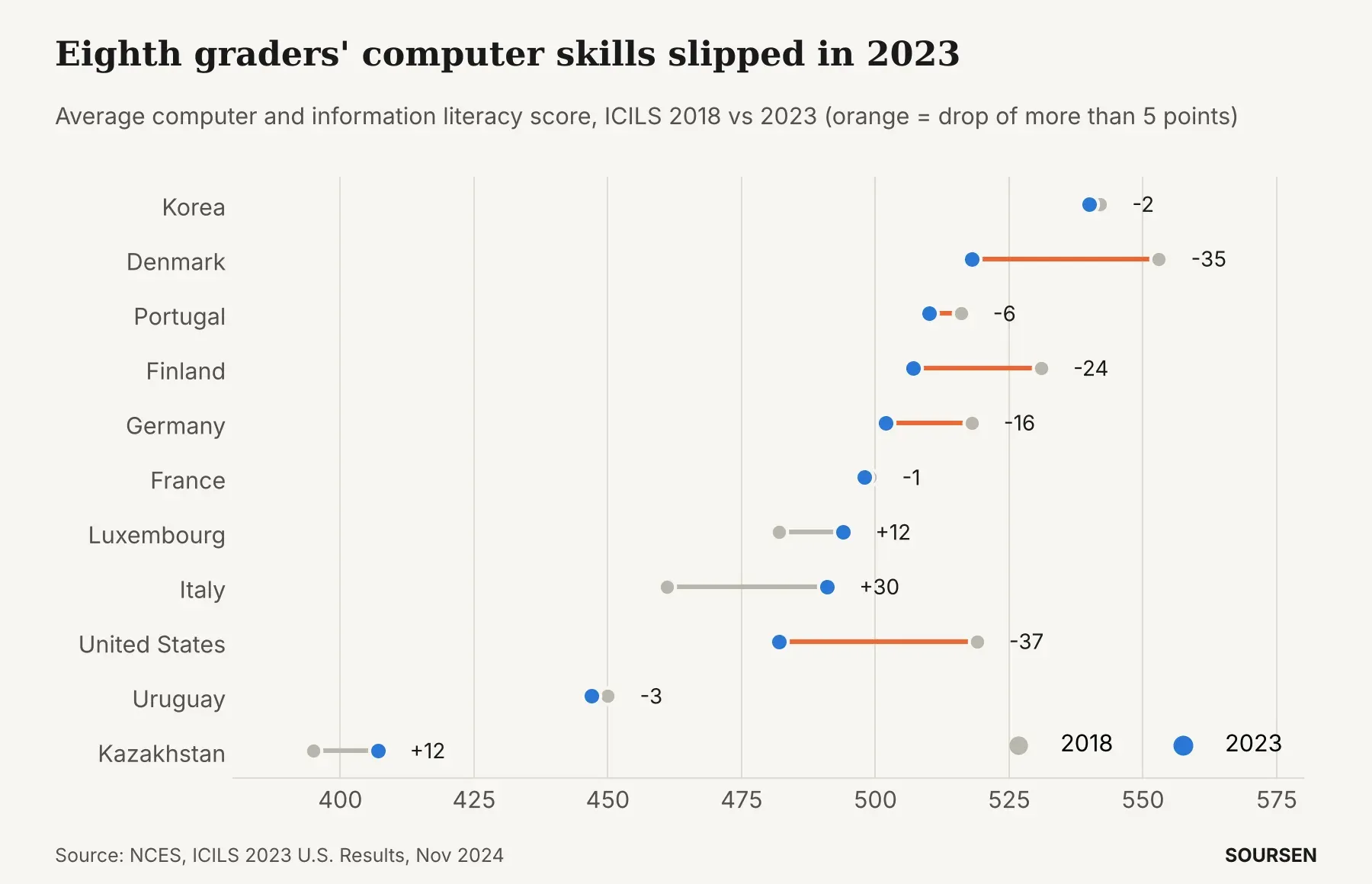
Eighth graders’ computer skills slipped in 2023. Average ICILS computer and information literacy scores in countries that took part in 2018 and 2023. Source: NCES, November 2024.
To be fair to the kids, a few systems improved. Italy gained 30 points and Luxembourg 12. The IEA also found students did better on computational thinking, where about 2 in 3 reached Level 2. The scale that slipped measures what the IEA calls the ability to use computers to investigate, create, participate and communicate, which is close to what most of us mean by basic computer literacy.
Adults are slipping too, and Europe has put a number on it
The decline goes beyond one test of eighth graders. The OECD’s 2023 Survey of Adult Skills assessed about 160,000 adults aged 16 to 65 in 31 countries and found that 18% of adults lack even the most basic proficiency in literacy, numeracy and adaptive problem solving. Over the past decade only Finland and Denmark improved adult literacy significantly, according to the OECD’s editorial, while the rest stagnated or declined. The test itself was taken on tablets, which says something about where computing has moved.
The European Union tracks digital skills directly. In 2023, 56% of people aged 16 to 74 had at least basic digital skills, far from the EU’s goal of 80% by 2030, according to Eurostat. Eurostat’s own releases round the figure to 55% or 56%, and the European Commission’s research arm uses 55.6%. The Netherlands led at 83% and Romania trailed at 28%. Young people do better, yet the Commission’s Joint Research Centre found that 32% of 16 to 24 year olds still show below basic digital skills, rising to 43% for young people with little formal education.
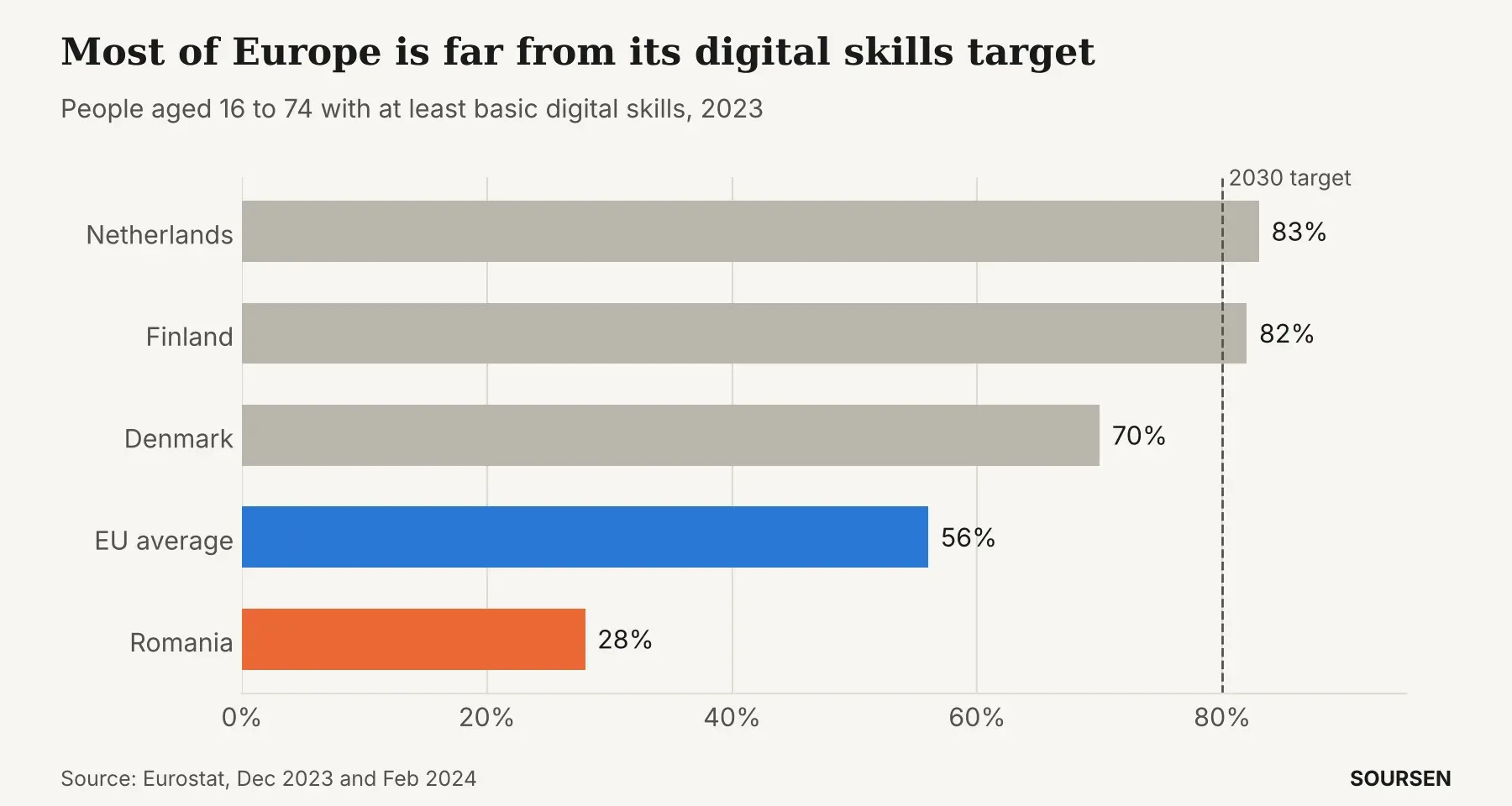
Most of Europe is far from its digital skills target. People aged 16 to 74 with at least basic digital skills, 2023. Source: Eurostat, February 2024.
“Digital native” was a slogan that never had evidence behind it
The phrase digital native comes from writer Marc Prensky in 2001. It suggested kids raised around technology would absorb it naturally. In 2017, educational psychologists Paul Kirschner and Pedro De Bruyckere reviewed the evidence in Teaching and Teacher Education and concluded that information savvy digital natives do not exist.
Growing up with a device teaches you that device. Spend 10 years inside an iPad and you will be very good at an iPad. Put the same person in front of a Windows file dialog or a Linux desktop and the skills do not transfer, because they were never general skills.
The workplace data agrees. In an HP survey of 10,000 office workers, 1 in 5 young workers said they felt judged when they had tech problems, compared with 1 in 25 of their older colleagues, as Fortune reported. HP called it “tech shame.” Young employees are assumed to be the office IT experts, and many quietly are not.
Schools handed students Chromebooks and iPads
A big reason is what schools bought. In 2015, Chrome OS devices made up 50% of all devices shipped to US K12 schools, ahead of Windows at 22%, iOS at 19% and Mac OS at 6%, according to Futuresource Consulting via THE Journal. Chromebooks had gone from under 1% of US classroom devices to over 50% in about 3 years, as GSMArena reported from CNBC’s coverage.
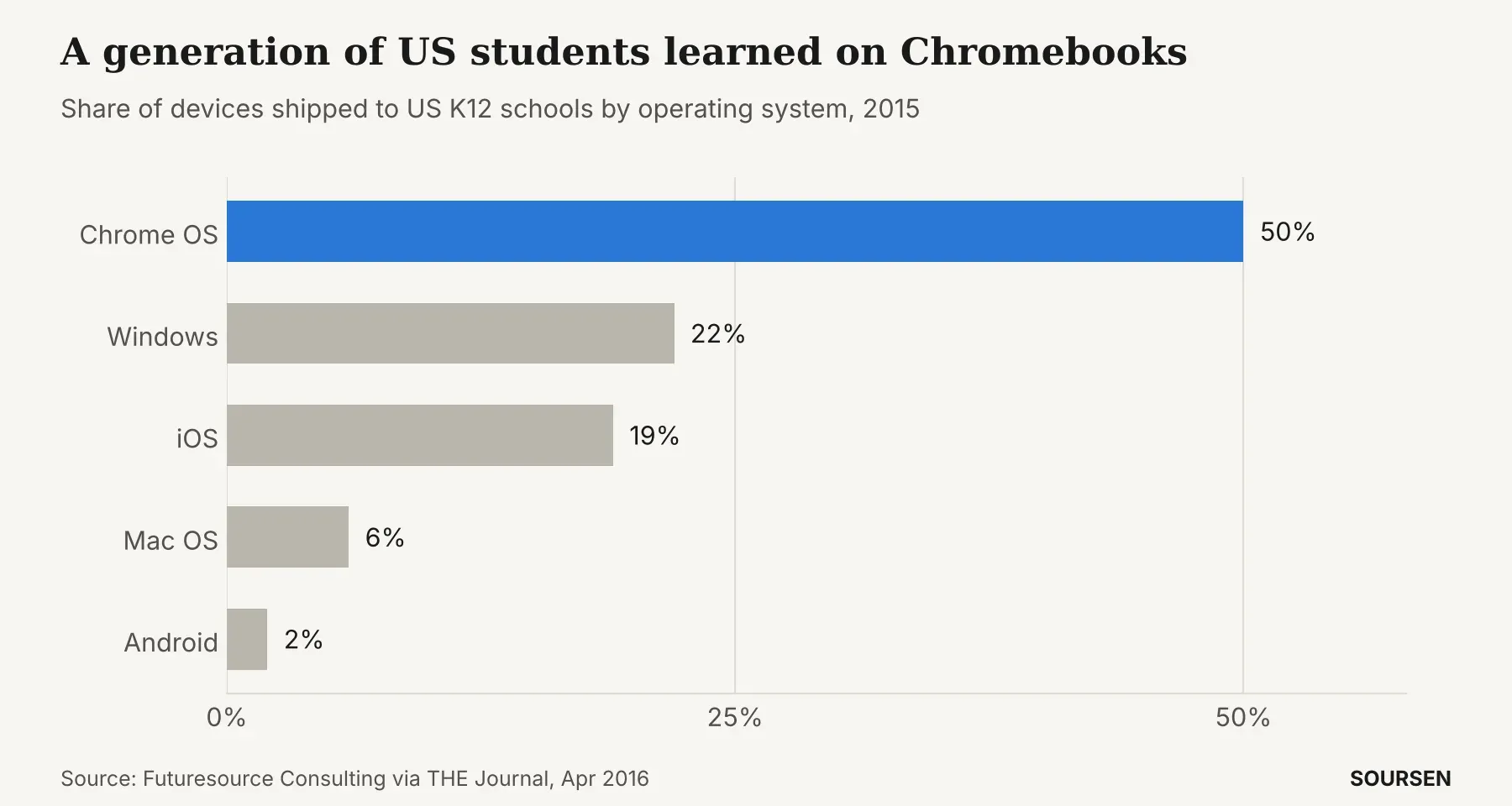
A generation of US students learned on Chromebooks. Share of devices shipped to US K12 schools by operating system. Source: Futuresource Consulting via THE Journal, April 2016.
I like Chromebooks for schools. They are cheap, easy to manage and hard to break. They were also built around the browser and Google’s cloud, so students rarely need to manage local files, run an installer or fix a broken driver. A student who turned 18 this year was about 7 years old in 2015. Many went through school on a managed browser, then got to university and met a full computer for the first time.
For many young people the phone is the computer
Outside school, the phone wins. In Pew Research Center’s 2025 survey, 16% of US adults were smartphone dependent, meaning they had a smartphone and no home broadband. Among adults aged 18 to 29 the figure was 27%, the highest of any age group. Pew’s tracking shows the overall share has hovered around 15% to 16% since 2021.
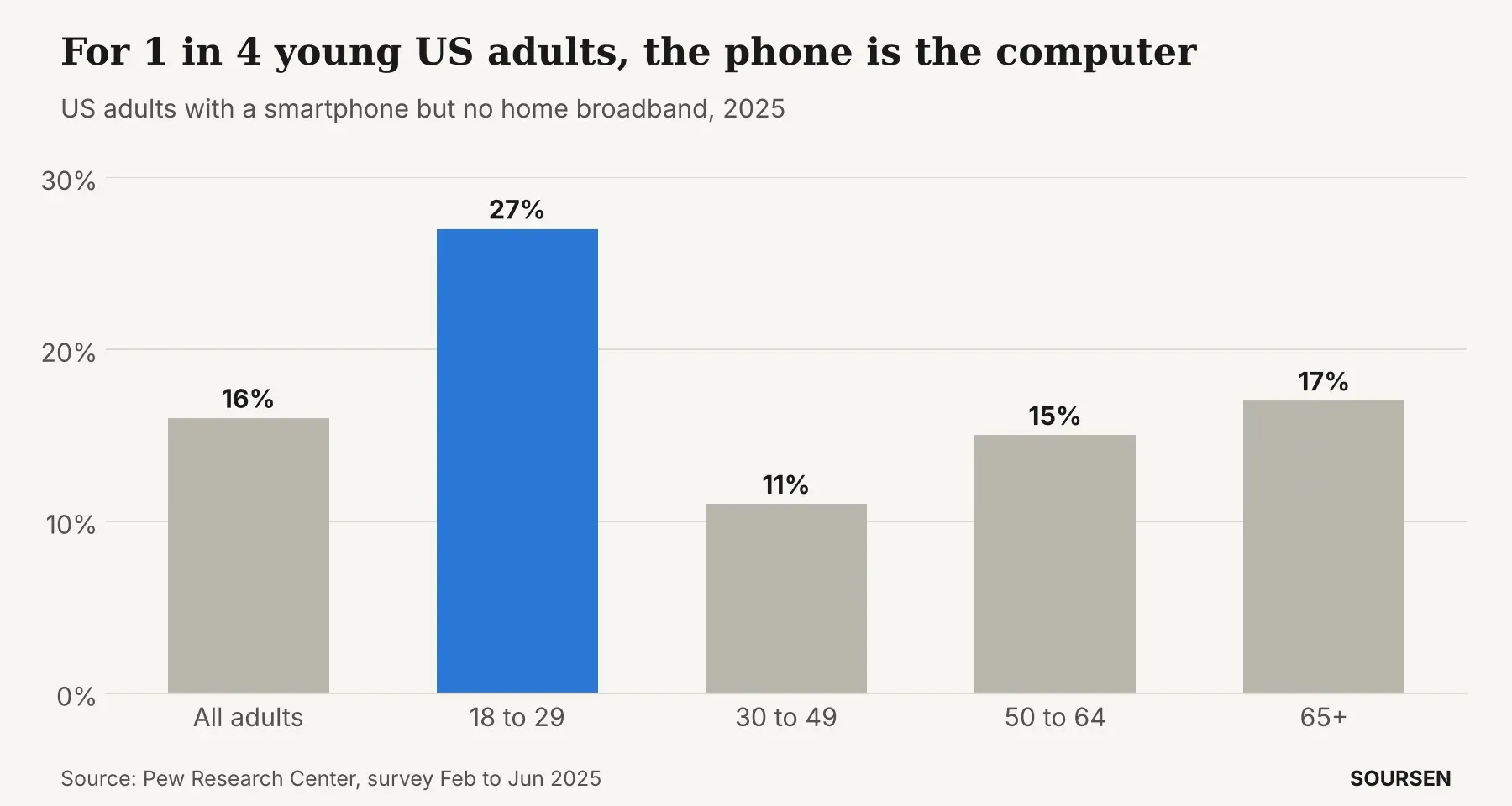
For 1 in 4 young US adults, the phone is the computer. US adults with a smartphone and no home broadband, by age. Source: Pew Research Center, 2025.
India shows the same pattern at a much larger scale, and this is the data I find most striking. In the government’s Comprehensive Annual Modular Survey for July 2022 to June 2023, 96.1% of people aged 15 to 24 could use a mobile phone and 78.4% could send messages with attached files. Only 71.2% could use copy and paste to move data, and just 26.8% could search the internet, send email and bank online, according to the Ministry of Statistics press release. The rural figure for that last bundle was 21.0%, against 40.2% in cities.
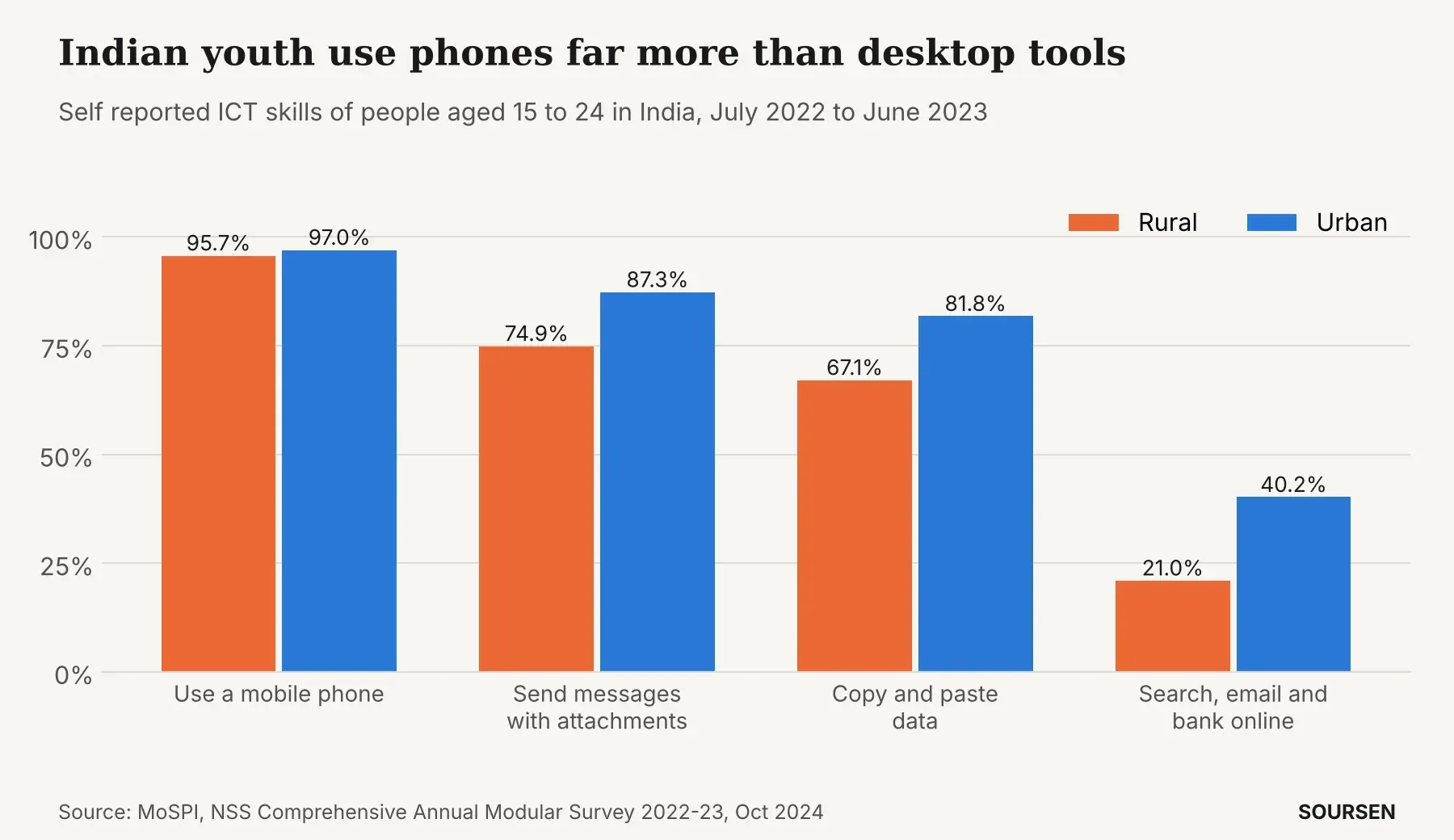
Indian youth use phones far more than desktop tools. Self reported ICT skills of people aged 15 to 24, rural and urban. Source: Ministry of Statistics and Programme Implementation, October 2024.
These numbers are self reported. The ministry notes in its later telecom survey that it did not test anyone’s skills, so the true figures could be lower. Earlier survey data from the same system led ThePrint to report that 73% of Indians aged 15 to 29 lacked routine email skills and fewer than 3% said they could code. My read is that for many young Indians the PC is a work tool they meet late, if at all.
Computer classes changed, and the basics fell through the gap
The Reddit post blamed schools for cutting computer classes. The picture varies by country, and England is the clearest case. England replaced its ICT curriculum with computing in 2014. The government declined to renew the ICT GCSE in 2015, and the last exams took place in 2019, according to a King’s College London timeline. The Royal Society’s 2017 report found that only 11% of pupils chose GCSE computer science, compared with 14% who had chosen ICT. Later research reported by TES found computing and ICT qualification entries at Year 11 fell by 144,000, or 45%, between 2017 and 2018.
Computer science and computer literacy are different subjects. A student can pass a programming course without ever learning where downloads go, how to spot a fake installer or what to do when Wi-Fi drops. A commenter on a Schools Week article argued that ICT was scrapped because of a false belief that students were already confident with office tools.
The US shows a similar plateau. Code.org’s 2025 report found 60% of public high schools offered foundational computer science in the 2024 to 2025 school year, the same as the year before, and only 6.1% of eligible students enrolled. Critics such as this Slashdot analysis have pointed out that the school level access metric can understate how many students attend a school with a CS course, so treat the 60% as a rough guide.
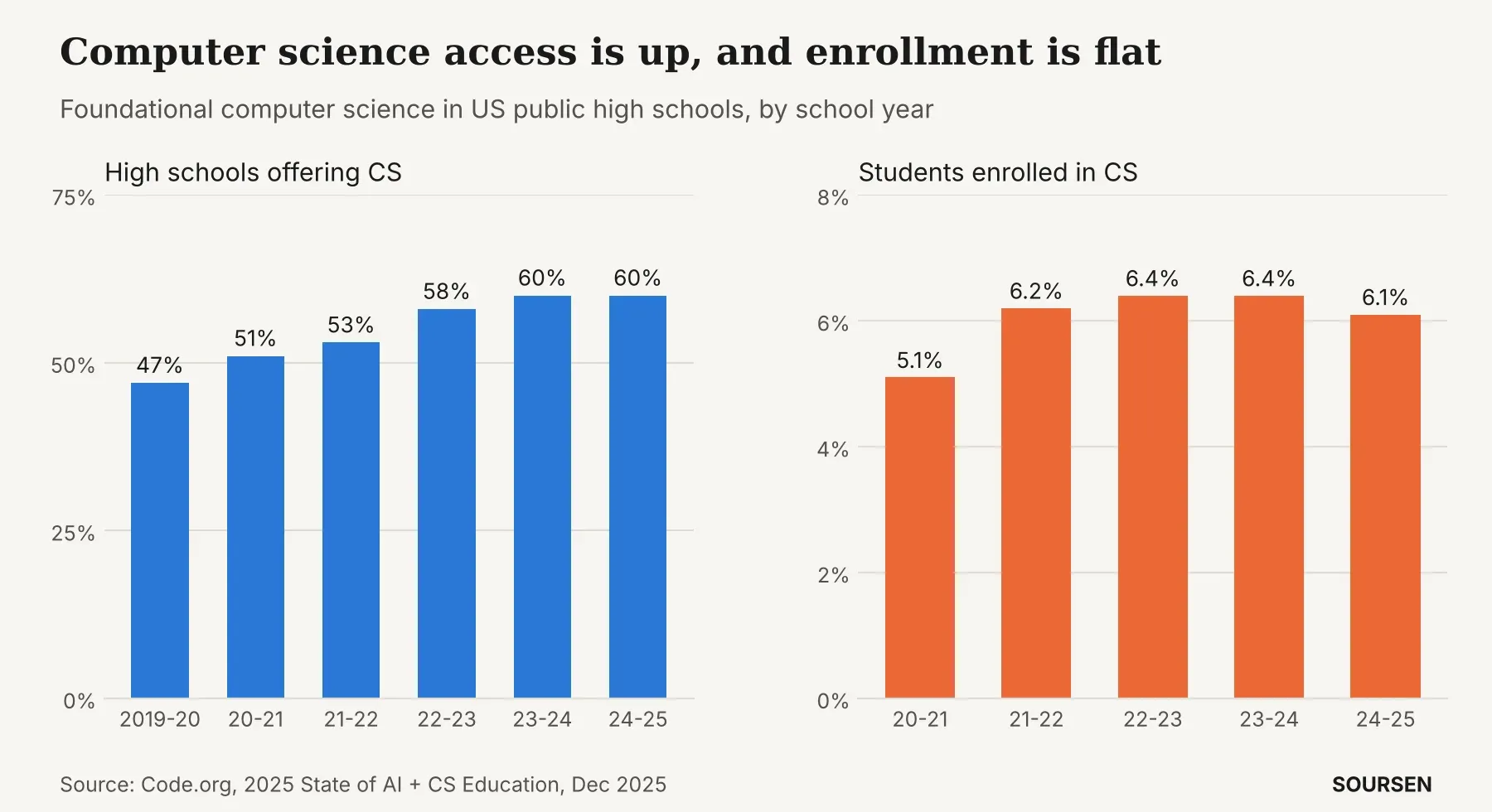
Computer science access is up, and enrollment is flat. Foundational CS in US public high schools by school year. Source: Code.org, December 2025.
“Sideloading” teaches people that installing software is dangerous
The student who did not trust downloads points at a word worth questioning. On a PC, downloading an installer from a developer’s website is just installing software. On a phone it has a scarier name. Apple’s 2021 paper was subtitled A threat analysis of sideloading, and it argued that allowing apps from outside the App Store would undermine iPhone security. The same paper claimed Android devices had 15 to 47 times more malware infections than iPhones, a figure The Register questioned because Apple does not publish comparable transparency data.
The security concern is genuine. Google says it found more than 50 times more malware from internet sideloaded sources than from Google Play, according to TechCrunch. On September 30, 2026, Google began requiring that apps on certified Android devices in Brazil, Indonesia, Singapore and Thailand come from verified developers, with a global rollout planned for 2027, as Android Authority reported. Users can still install unverified apps through an advanced flow that, per The Hacker News, requires developer mode, a restart, a 24 hour wait and reauthentication. F-Droid, the free software app store, has said the requirement would end its project.
Desktops are tightening too. In macOS Sequoia, Apple removed the Control click shortcut that let users open apps Gatekeeper blocks, so users now have to go into System Settings to approve them, as MacRumors reported. Meanwhile, under the EU’s Digital Markets Act, Apple has allowed alternative app marketplaces in the EU since iOS 17.4 in March 2024, with notarization checks on every app.
Each of these steps has a defensible security reason. Added together, they teach a generation that software comes from one approved store and anything else is a hack. Linux runs the other way. You add repositories, you install from Flathub or the AUR, you edit config files. A user trained to fear “sideloading” brings that fear to Linux on day one.
One Indian state already teaches computing on Linux
The idea that beginners learn more on a system with rough edges has a working example in India. Kerala made IT a compulsory school subject with practical exams in 2003 and completed a move to free software by 2006, according to KITE’s history. Its schools run KITE GNU/Linux, a custom Ubuntu based distro, on more than 200,000 computers. KITE estimated the choice saved about ₹3,000 crore in licence costs, and its chief K Anvar Sadath said proprietary software would have cost at least ₹1.5 lakh per computer, as It’s FOSS reported. KITE released a version based on Ubuntu 22.04 in 2024.
I have not seen an independent study comparing Kerala students’ computer skills with students elsewhere, so I will not claim the program works better. It does show that a government can put Linux in front of millions of children as their first computer, at scale, for over 20 years. It is one of the largest working tests of the learn on rough edges idea.
Linux asks for the exact skills that are disappearing
The instructor’s sharpest line was that Linux’s greatest feature is the agency it gives users, and that this is also the problem, because in the instructor’s experience the vast majority of young users neither know what to do with that agency nor want it. The same post noted it took an hour to get speakers working after the fresh Fedora install. When other operating systems break, the instructor wrote, students take the device back to the store, and if that fails they replace it. The post also argued that Windows and macOS get worse every year because they cater to this kind of helplessness.
I agree with half of this. Linux is far friendlier than it was 10 years ago, and distros like Linux Mint, Fedora and Bazzite need very little terminal work for everyday use. When something breaks, though, the fix still assumes you know what a driver, a package or a file path is. Windows and macOS hide those layers more aggressively every year, and Microsoft is now pitching Windows as an agentic operating system where AI handles more tasks for you.
The post also argued that Linux Mint is no answer either, because the issue is agency itself and a stripped down, simplified desktop does not fix that. I would push back here. AI chatbots now walk people through Linux problems step by step, and the same tools that make students passive can also explain what a mount point is when asked. Students are certainly using them. Pew found that 26% of US teens used ChatGPT for schoolwork in 2024, double the 13% of 2023, and by late 2025 just over half of teens said they had used chatbots for schoolwork. Whether a student asks the follow up question depends on whether anyone taught them to.
A common reply in Linux circles uses a driving analogy. New drivers start in a cheap economy car, and some argue new computer users would learn more on a system with rough edges. I think there is something to that, and an old laptop running Linux Mint or Fedora is a cheap way to test it.
The claim that we are the last generation who understands computers goes too far
A popular reaction to posts like this is that everyone who cares about computers is now one of the boomers, the last generation who knows how they work. I understand the feeling, and I think it overreaches. Korea’s eighth graders held their ICILS score steady at the top of the table. Computational thinking scores were stronger than basic literacy. Plavchan’s soldering comparison reminds us that every generation of professors has said this about every generation of students.
The default has changed. Earlier generations learned files and folders because computers forced them to. Today’s devices remove that friction on purpose, so the skill has to be taught on purpose. If nobody teaches it, a small group of hobbyists will keep the knowledge, and Linux will keep growing mostly among people who already have it.
2 things from this generalize
The first is that ease of use and understanding pull in opposite directions. Every layer a platform hides makes it easier on day one and harder on the day something breaks. ICILS scores fell during the same decade devices got easier. That is a correlation, and I find it hard to wave away.
The second is that Linux adoption depends on education more than features. Photoshop patches and Steam Machines bring in people who already understand computers. The next 10% of users will come from wherever basic computer literacy gets taught again, whether that is a school, a library, a repair café or a parent at a kitchen table.
This week, sit with one younger person in your life, ask them to save a file, move it into a new folder and find it again without using search, and walk them through the parts they get stuck on.
Sources
- Reddit r/linux, AntiqueReplica, The Year of Linux isn't comingreddit.com. Accessed 20 November 2026.
- TechnologyChecker, Linux market share 2026technologychecker.io. Accessed 20 November 2026.
- Phoronix, Steam on Linux October 2026phoronix.com. Accessed 20 November 2026.
- openSUSE News, End of 10 campaignnews.opensuse.org. Accessed 20 November 2026.
- The Verge, File Not Foundtheverge.com. Accessed 20 November 2026.
- TechSpot, students and files and folderstechspot.com. Accessed 20 November 2026.
- PC Gamer, students don't know what files and folders arepcgamer.com. Accessed 20 November 2026.
- IEA, ICILS 2023 International Reportiea.nl. Accessed 20 November 2026.
- Springer, ICILS 2023 student achievement chapterlink.springer.com. Accessed 20 November 2026.
- Springer, ICILS 2023 implications chapterlink.springer.com. Accessed 20 November 2026.
- NCES, ICILS 2023 U.S. Resultsnces.ed.gov. Accessed 20 November 2026.
- Kirschner and De Bruyckere, The myths of the digital native and the multitasker (2017)gwern.net. Accessed 20 November 2026.
- Fortune, Gen Z and tech shamefortune.com. Accessed 20 November 2026.
- THE Journal, Chromebooks account for half of K-12 shipmentsthejournal.com. Accessed 20 November 2026.
- GSMArena, Chromebooks pass 50% of US classroom devicesgsmarena.com. Accessed 20 November 2026.
- Pew Research Center, smartphone dependence by group (2025)pewresearch.org. Accessed 20 November 2026.
- Pew Research Center, Mobile Fact Sheetpewresearch.org. Accessed 20 November 2026.
- Ministry of Statistics, CAMS 2022-23 resultspib.gov.in. Accessed 20 November 2026.
- Ministry of Statistics, CMS Telecom 2025 summarystatic.pib.gov.in. Accessed 20 November 2026.
- ThePrint, 73% of youth lack basic email skillstheprint.in. Accessed 20 November 2026.
- King's College London, computing provision reportscari.sites.er.kcl.ac.uk. Accessed 20 November 2026.
- ITPro, Royal Society After the rebootitpro.com. Accessed 20 November 2026.
- TES, computing lessons down more than a thirdtes.com. Accessed 20 November 2026.
- Schools Week, computing take up after ICTschoolsweek.co.uk. Accessed 20 November 2026.
- Education Week, Code.org 2025 reportedweek.org. Accessed 20 November 2026.
- Code.org, 2025 State of AI + CS Education (PDF)academy.cis.fiu.edu. Accessed 20 November 2026.
- Apple, A threat analysis of sideloading (2021)apple.com. Accessed 20 November 2026.
- The Register, Apple warns sideloading will ruin everythingtheregister.com. Accessed 20 November 2026.
- TechCrunch, Google developer verificationtechcrunch.com. Accessed 20 November 2026.
- Android Authority, developer verification first waveandroidauthority.com. Accessed 20 November 2026.
- The Hacker News, Google sets September 30 deadlinethehackernews.com. Accessed 20 November 2026.
- MacRumors, macOS Sequoia Gatekeeper changemacrumors.com. Accessed 20 November 2026.
- MacRumors, iOS 17.4 alternative app marketplacesmacrumors.com. Accessed 20 November 2026.
- TechSpot, Microsoft shifts focus to stabilizing Windows 11techspot.com. Accessed 20 November 2026.
- IEA, Launch of the ICILS 2023 resultsiea.nl. Accessed 20 November 2026.
- Slashdot, critique of the Code.org access metrictech.slashdot.org. Accessed 20 November 2026.
- StatCounter, Android share across platformsgs.statcounter.com. Accessed 20 November 2026.
- IEA, ICILS 2023 study pageiea.nl. Accessed 20 November 2026.
- OECD, Survey of Adult Skills 2023oecd.org. Accessed 20 November 2026.
- OECD, Survey of Adult Skills 2023 editorialoecd.org. Accessed 20 November 2026.
- Eurostat, Skills for the digital ageec.europa.eu. Accessed 20 November 2026.
- Eurostat, Digital skills in 2023ec.europa.eu. Accessed 20 November 2026.
- European Commission JRC, reaching the 80% digital skills targetjoint-research-centre.ec.europa.eu. Accessed 20 November 2026.
- Wikipedia, KITE Keralaen.wikipedia.org. Accessed 20 November 2026.
- It's FOSS, Kerala schools save with Linuxitsfoss.com. Accessed 20 November 2026.
- It's FOSS, KITE GNU Linux 22.04itsfoss.com. Accessed 20 November 2026.
- Pew Research Center, teens and ChatGPT for schoolwork (2025)pewresearch.org. Accessed 20 November 2026.
- Pew Research Center, how teens use and view AI (2026)pewresearch.org. Accessed 20 November 2026.
Related stories
More in Linux
Linux & open source
Apple Never Documented the M1. A Handful of Volunteers Taught Linux to Run on It Anyway, Then Most of Them Left
Asahi Linux reverse engineered Apple Silicon from scratch and shipped the first conformant graphics drivers for Apple's GPU on any operating system. In 2025 its founder quit after a fight over Rust in the Linux kernel, and 2 of its graphics developers stepped away within months. I walk through how they did it, why it fell apart and where Linux on the Mac stands in November 2026.

Linux & open source
Just Read the Code, Bro. 9 Linux Takes That Fall Apart When You Check the Numbers
Starter distros, lazy developers, fragmentation, donation guilt and the old claim that open source is less secure. I checked each one against 2026 data, and most of them do not survive.

Linux & open source
He Asked Synaptics for Help With a Linux Driver. The Reply Was a $25,000 a Week Legal Demand.
A hobbyist wrote an open source Rust driver for DisplayLink docks and posted it for kernel review. Synaptics answered with patent letters, the repository is offline, and no court has ruled on anything. I go through the dates, the 2 patents and how far a clean room reaches.